Blast Best Vibe Coding Tools (Games Stack 2026)

By Arron R.13 min read
The best vibe coding tools in 2026 are a stack, not one pick. Sorceress WizardGenie plans and executes browser games with the 8-model rotation, Sorceress Code e

Search best vibe coding tools in September 2026 and every top result is a different lane. Cursor Pro at $20 owns the local IDE agent seat. Windsurf (Devin Desktop) Pro at $20 splits that same seat with daily and weekly quotas. Lovable Pro at $25 and Bolt.new Pro at $25 own the prompt-to-app scaffolder seat. v0 Plus at $30 per user owns the Vercel-deploy seat. GitHub Copilot Pro at $10 owns the completion-first seat. Replit Core at $20 owns the container-plus-agent seat. And Sorceress WizardGenie plus Sorceress Code own the browser-native game-dev seat with an 8-model rotation and BYO keys. This piece charts the honest 2026 stack - not one best pick, one stack per lane - and prints the game-dev workflow that actually ships a Phaser or Godot prototype in a weekend. Every price and feature below was verified 2026-09-13 against the vendor pricing pages and the Sorceress source in src/app/_home-v2/_data/tools.ts and src/app/code/page.tsx.
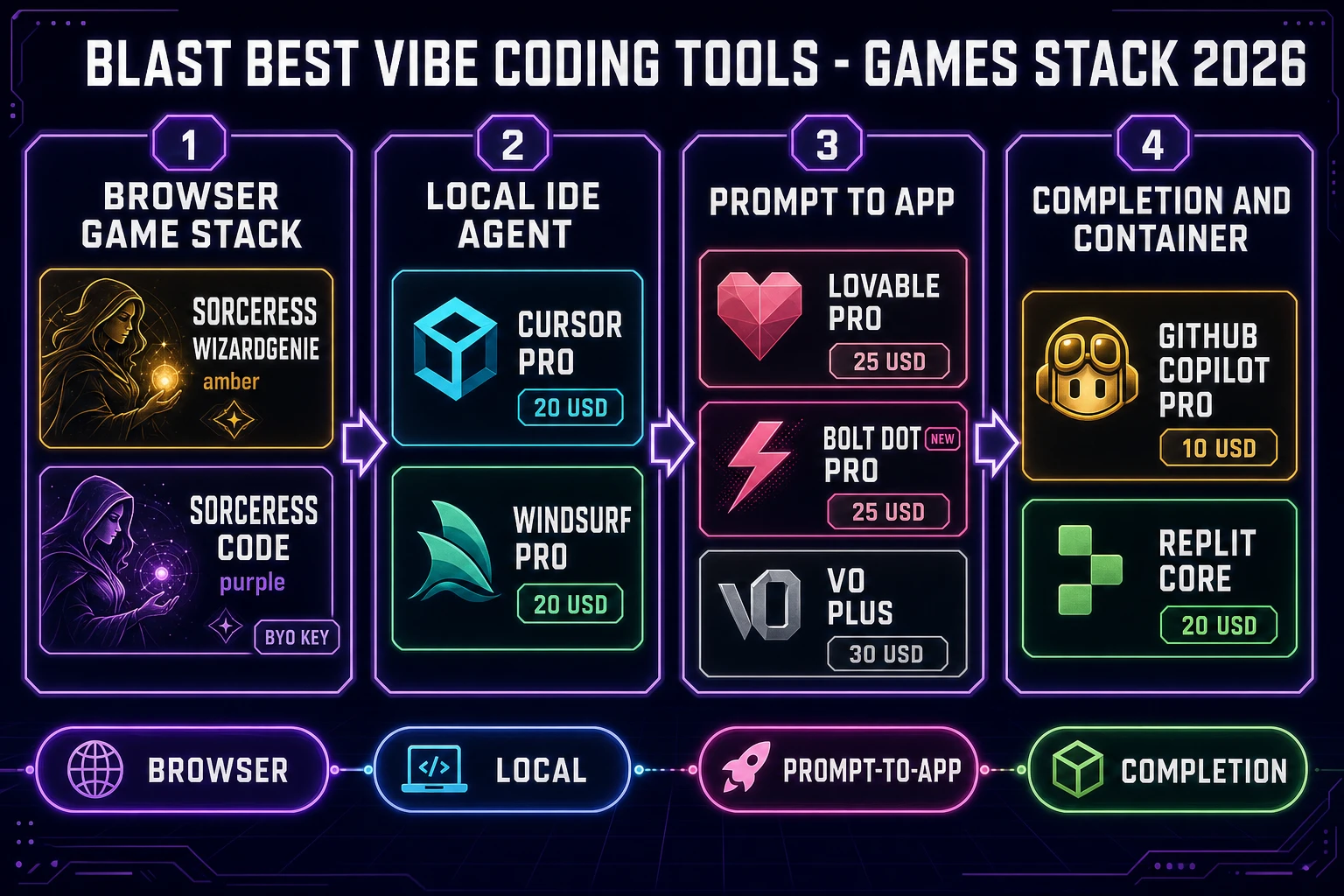
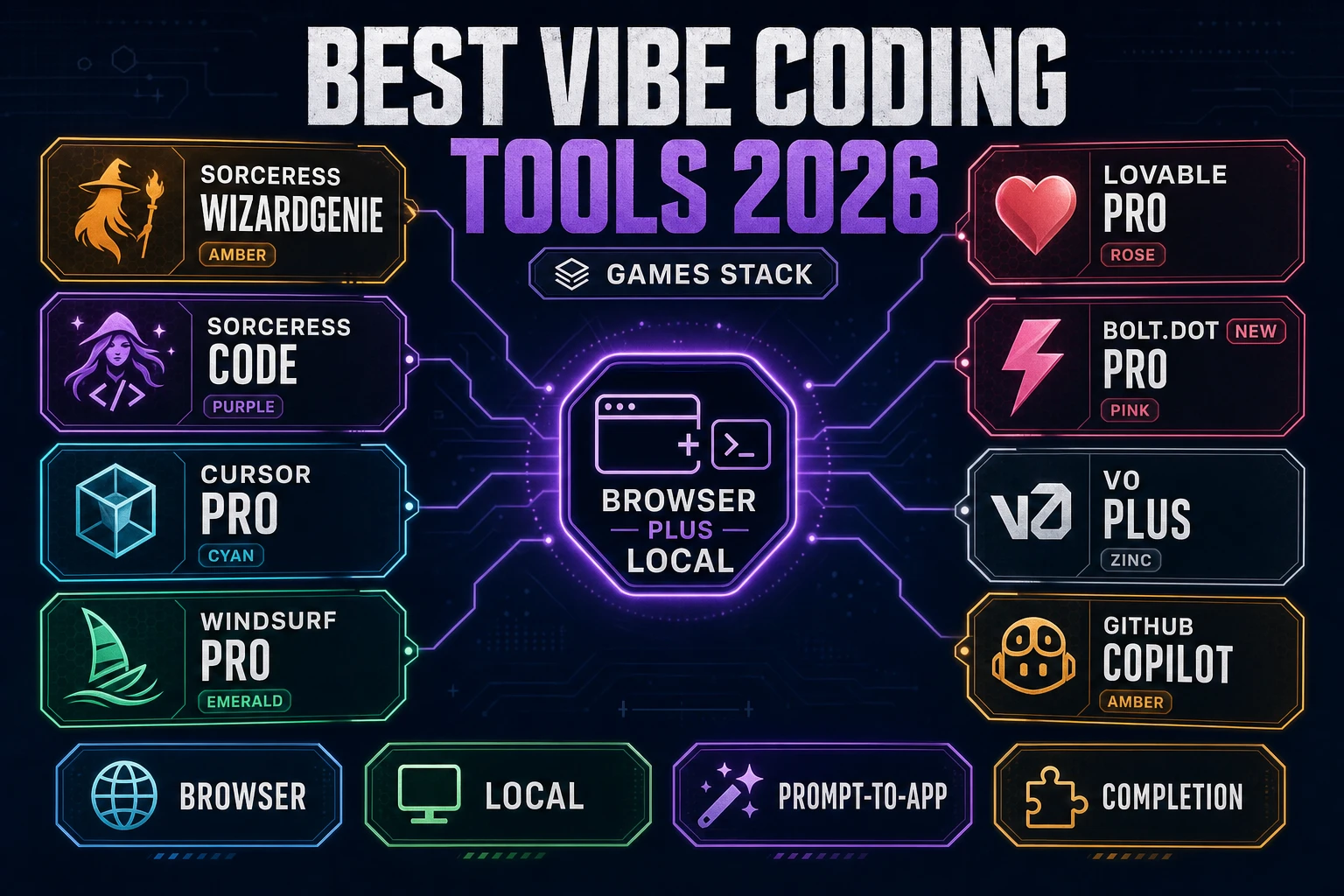
Chart of the best vibe coding tools in 2026 showing four lanes browser game stack with Sorceress WizardGenie and Sorceress Code local IDE with Cursor Pro and Windsurf Pro prompt to app with Lovable Bolt.new and v0 and completion with GitHub Copilot Pro and Replit Core
The 2026-09-13 chart of the best vibe coding tools splits into four lanes - browser game stack, local IDE agent, prompt-to-app scaffolder, and completion-plus-container - and no single tool wins every lane.

What vibe coding tools actually means in 2026

The phrase vibe coding was popularized in early 2025 to describe a workflow where a person describes an app or a game in plain English and an AI writes the code, tests it, and hands back a running artifact - all without the person typing the code themselves. By 2026 the vibe coding tools category has fractured into four subcategories, and the best pick depends on which of the four jobs matches the task at hand.

Browser-native game stack tools write and preview code in the same tab, keep the runtime rendering live, and are engine-aware for Phaser, Three.js, Godot HTML5 exports, and similar targets. Sorceress WizardGenie is the anchor of this lane. Local IDE agents edit real files on disk inside a code editor and are engine-agnostic. Cursor and Windsurf split this seat. Prompt-to-app scaffolders take a description and ship a full-stack web dashboard with a database, authentication, and a deploy target. Lovable, Bolt.new, and v0 sit here. Completion-plus-container tools autocomplete inside an existing editor or provide the AI plus the containerized sandbox to run the result. GitHub Copilot and Replit Core cover this. Every price cited below was verified 2026-09-13 against the vendor pricing page linked at the bottom of the article.

The tool categories that matter for game dev

Game development is not a subset of web app development, so the mainstream vibe coding tools bench needs to be reordered for game work. A game project touches five surfaces the average SaaS project does not - a game loop with delta-time timing, a canvas or WebGL renderer, a sprite or 3D asset pipeline, a state machine for enemies and menus, and a physics or collision layer. Any evaluation of the best vibe coding tools for game development has to score how each contender handles those five surfaces.

Lane What it does Game-dev fit Anchor tools
Browser game stackWrites code and renders the running game in the same tab, engine-aware for Phaser 4 and Three.jsNative fitSorceress WizardGenie + Sorceress Code
Local IDE agentEdits real files on disk in a VS Code fork, generic across languagesGood fit for Unity C# and Godot GDScriptCursor Pro, Windsurf Pro
Prompt-to-app scaffolderShips a full-stack web dashboard with a DB and a deploy targetPoor fit for browser games, good fit for game backendsLovable Pro, Bolt.new Pro, v0 Plus
Completion-plus-containerAutocomplete inside an existing editor plus a sandbox to run the resultSolid autocomplete lane, weak on cross-file game reasoningGitHub Copilot Pro, Replit Core

The other constant across every one of the best vibe coding tools is the underlying model rotation. Cursor, Windsurf, Lovable, Bolt.new, v0, Copilot, and Replit all route to the same handful of frontier models - Anthropic Claude, OpenAI GPT, Google Gemini, xAI Grok - just with different UIs, different context strategies, and different price wrappers. That is why the honest comparison is a lane comparison, not a model comparison. A shop that already pays for Claude Opus 4.7 tokens on the Anthropic side pays for them again through Cursor, again through Windsurf, again through Lovable. The Sorceress WizardGenie plus Code approach breaks that pattern with BYO keys.

Sorceress WizardGenie as the browser-native vibe coding tool

Sorceress WizardGenie is the browser-native anchor of the game-dev lane. Verified 2026-09-13 in src/app/wizard-genie/page.tsx lines 297 to 316, WizardGenie ships a dual-agent Planner plus Executor split where a smart Planner drafts the change plan and a cheaper Executor types it - the pattern that keeps output-token cost at roughly a quarter of a single-model workflow. WizardGenie also ships Mem Palace plus Graphify long-term memory so the agent remembers project conventions across sessions, agentic web browsing so the agent can search documentation autonomously, and a Voxel World Builder plus VFX tooling that produces Three.js and Phaser assets you can drive in plain English.

The eight-model rotation behind WizardGenie is the same rotation the standalone Sorceress Code page exposes, verified 2026-09-13 in src/app/_home-v2/_data/tools.ts lines 766 to 775 - Claude Opus 4.7 (Top tier), Claude Sonnet 4.6 (Fast + smart), GPT-5.5 (Frontier), Gemini 3.1 Pro (1M context), DeepSeek V4 Pro (Budget), Kimi K2.5 (256K coding), Grok 4.2 (2M context), and MiniMax M2.7 (Agent-ready). Reach for Opus 4.7 as the planner on a hard scene-lifecycle refactor. Reach for Gemini 3.1 Pro when the paste is a whole Godot repo. Reach for DeepSeek V4 Pro on the executor lane when the wallet matters. Every one of those model choices is a single click in the WizardGenie model picker, not a plan upgrade.

Sorceress Code as the file-aware vibe coding tool

Sorceress Code is the file-aware cousin of WizardGenie and it fills the local IDE agent lane for the game-dev subset of vibe coding tools. Verified 2026-09-13 in src/app/code/page.tsx lines 1150 to 1181, Sorceress Code exposes four BYO-key provider slots - anthropic, deepseek, openai, nvidia - and the keys live only in browser localStorage, never on Sorceress servers. Line 1178 confirms the UI banner: API keys are stored in localStorage for security, not sent to our servers. That means a team on the free Sorceress plan can still route to Claude Opus 4.7, DeepSeek V4 Pro, GPT-5.5, or the NVIDIA-hosted Kimi K2.5 free-trial endpoint without paying Sorceress on every token. The CREDITS_PER_DOLLAR = 100 constant in src/lib/models.ts confirms Sorceress-managed model usage is priced at pass-through cost - one credit equals one US cent of underlying provider spend.

Sorceress Code also connects to a local filesystem bridge for real file edits on disk, which is the seat Cursor and Windsurf occupy on the generic side. The sorcgcs_server_url localStorage key in src/app/code/page.tsx line 1846 confirms this - it points the browser-hosted UI at a small local Node server that owns the write side, so no code ever crosses a Sorceress server on the way to a file. That local-bridge design is why Sorceress Code deserves a seat in the best vibe coding tools list rather than getting scoped to browser-only games.
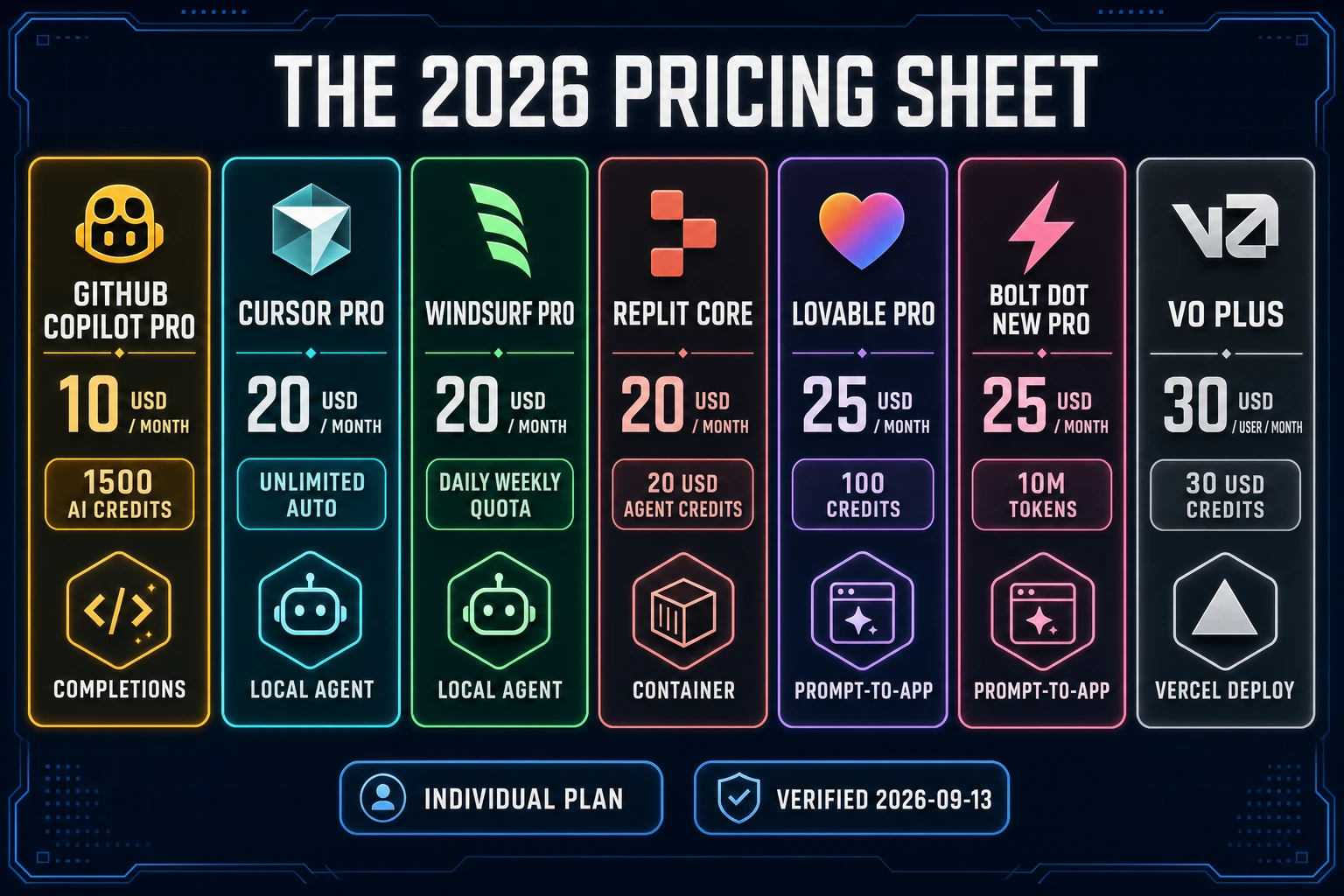
Vibe coding tool price comparison sheet for 2026 showing GitHub Copilot Pro 10 USD Cursor Pro 20 USD Windsurf Pro 20 USD Replit Core 20 USD Lovable Pro 25 USD Bolt.new Pro 25 USD v0 Plus 30 USD
The 2026-09-13 pricing sheet across the best vibe coding tools - all individual paid plans, all verified against the vendor pricing page today.

The competitor bench - Cursor, Windsurf, v0, Lovable, Bolt, Copilot, Replit

The generic-side vibe coding tools each own a seat that Sorceress does not compete for. This is the honest 2026 bench, with every plan price and every feature verified 2026-09-13 against the vendor pricing page.

Cursor Pro at $20 - local IDE agent seat

Cursor Pro is $20 per month. Verified 2026-09-13 on the Cursor pricing page: Pro includes unlimited Auto model routing (unlimited use of the Cursor-first-party Cursor Grok 4.6, Grok 4.5, and Composer 2.5 pool), a $20 monthly credit pool for manually selecting frontier models like Claude Opus, unlimited tab completions, and Cloud Agents. Pro Plus is $60, Ultra is $200, and the India-only Start plan is priced at 649 rupees per month. Cursor is the safe pick when the project already lives in a VS Code fork and the workflow is generic language work - React, Rust, Python backends. Reach past Cursor when the target is a browser game rendered in Phaser or Three.js, since Cursor does not ship engine idioms or a live rendered preview.

Windsurf Pro at $20 - same lane, quota-based

Windsurf Pro is $20 per month and is now sold as Devin Desktop under Cognition. Verified 2026-09-13 against the Windsurf pricing page: Pro replaced the old 500-credit monthly pool with daily and weekly quotas that refresh automatically, tab autocomplete stays unlimited, and access to premium models (Claude Sonnet 4.6, GPT-5.4, SWE-1.5) is included. Max is $200, Teams is $40 per user, and the free tier ships a light daily quota with unlimited tab. Windsurf lands in the same seat as Cursor and the honest pick between the two is workflow preference - Cursor has a cleaner Auto experience, Windsurf has a more aggressive Cascade agent for multi-file edits.

Lovable Pro at $25 - prompt-to-app scaffolder

Lovable Pro is $25 per month for 100 monthly build credits, dropping to $21 per month billed annually. Verified 2026-09-13 against the Lovable pricing page: every plan includes 5 daily build credits (up to 30 per month on the free tier), 20 monthly Cloud credits for hosting and backend usage, and 4 monthly AI credits for AI features in user apps. Business is $50 for the same 100 base credits plus SSO and role-based access. Top-ups on Pro cost $15 per 50 credits. Lovable is the honest pick when the ask is a full-stack web dashboard with authentication and Supabase, and it is a poor pick for browser games - Lovable scaffolds React and Next.js, not Phaser scenes.

Bolt.new Pro at $25 - token-metered scaffolder

Bolt.new Pro is $25 per month for approximately 10M tokens with no daily cap. Verified 2026-09-13 against the Bolt.new tokens page: Free is $0 with 1M tokens per month and a 300K daily cap, Pro at $25 unlocks 10M tokens per month plus rollover for one additional month, Pro 50 at $50 unlocks 26M tokens, and Pro 100 at $100 unlocks 55M tokens. Teams is $30 per member per month. Bolt.new bills tokens rather than requests, which is where the surprise bills come from - a small platformer project can burn 3M tokens across debugging cycles. Reach for Bolt when the ask is a browser-rendered SPA or PWA, and reach past it for a Godot desktop build or a Unity C# project.

v0 Plus at $30 per user - the Vercel-deploy seat

v0 Plus is $30 per user per month with $30 in included monthly credits, $2 in free daily credits on login, and the ability to purchase additional credits at pass-through model rates. Verified 2026-09-13 against the v0 pricing page: Free ships $5 in monthly credits and a 7-message daily cap, Business is $100 per user with training opt-out, and the old Premium plan at $20 is being sunsetted for new users. v0 lands in the Vercel deploy seat rather than the general prompt-to-app seat because everything it ships is a Next.js app on Vercel infrastructure. Great for landing pages and Vercel-hosted marketing sites, poor fit for a Phaser browser game unless the game itself is a Next.js embed.

GitHub Copilot Pro at $10 - the cheapest paid entry

GitHub Copilot Pro is $10 per month with 1,500 monthly AI credits (1,000 base plus 500 flex). Verified 2026-09-13 against the GitHub Copilot plans docs: Pro Plus is $39 with 7,000 credits, Copilot Max is $100 with 20,000 credits, and 1 AI credit equals $0.01 USD. Copilot is the cheapest paid entry among the best vibe coding tools and it wins on completions inside an existing editor. It falls behind the file-aware agents on cross-file game reasoning - the agent mode on Copilot is competent but not as tuned to multi-file game work as the WizardGenie dual-agent split.

Replit Core at $20 - the container-plus-agent seat

Replit Core is $20 per month ($18 billed annually) with $20 in monthly Agent credits, Full build access, Design Canvas, Plan Mode, and 5 collaborator seats. Verified 2026-09-13 against the Replit pricing page: Starter is free with a daily agent cap, Pro is $100 per month with $100 in Agent credits and 15 collaborator seats plus Turbo Mode, and Teams was sunset into Pro. Replit is the honest pick when the ask is a container that runs the code with the AI in the same tab and does not need to touch the local filesystem. Replit does not ship engine-aware idioms for Phaser 4 the way WizardGenie does.

The honest game-dev workflow through vibe coding tools

The chart above is a menu, not a workflow. A real game-jam Monday on 2026-09-13 uses a stack of the best vibe coding tools rather than one pick. Here is the exact split Sorceress benched today.

Step Task Tool Why this tool, in 2026
1Sketch the pitch as a prompt-to-app landing page for the jam entry submission formLovable Pro or v0 PlusPrompt-to-app scaffolders ship a landing page with auth and a DB in one prompt
2Draft the Phaser 4.2.1 scene and game loopSorceress WizardGenie (Claude Opus 4.7 planner)Engine-aware idioms for Phaser 4, live rendered preview in the browser
3Edit real files on disk for Unity C# or Godot GDScript scenesSorceress Code (BYO key) or Cursor Pro or Windsurf ProLocal file bridge with agent chat, engine-agnostic across Unity and Godot
4Autocomplete inside VS Code while hand-editing a shader or a Cinemachine profileGitHub Copilot ProCompletion-first UX, cheapest paid seat at $10
5Publish the browser build to a shareable URL for playtestersSorceress Publishing or Replit CoreSorceress Arcade for the game itself, Replit for the tooling container around it
6Generate a Steam capsule art placeholder and a short trailer clipSorceress AI Image Gen + AI Video GenNative game-art tooling on the same account as the code tools

The stack works because each tool fills a lane no other tool covers. WizardGenie owns the browser game stack lane. Cursor and Windsurf own the local IDE lane. Lovable and Bolt.new own the prompt-to-app lane. v0 owns the Vercel deploy lane. Copilot owns the completion lane. Replit owns the container lane. The mistake is trying to jam a single tool into every lane, which is what happens when a searcher lands on a best vibe coding tools post that names one product and stops.

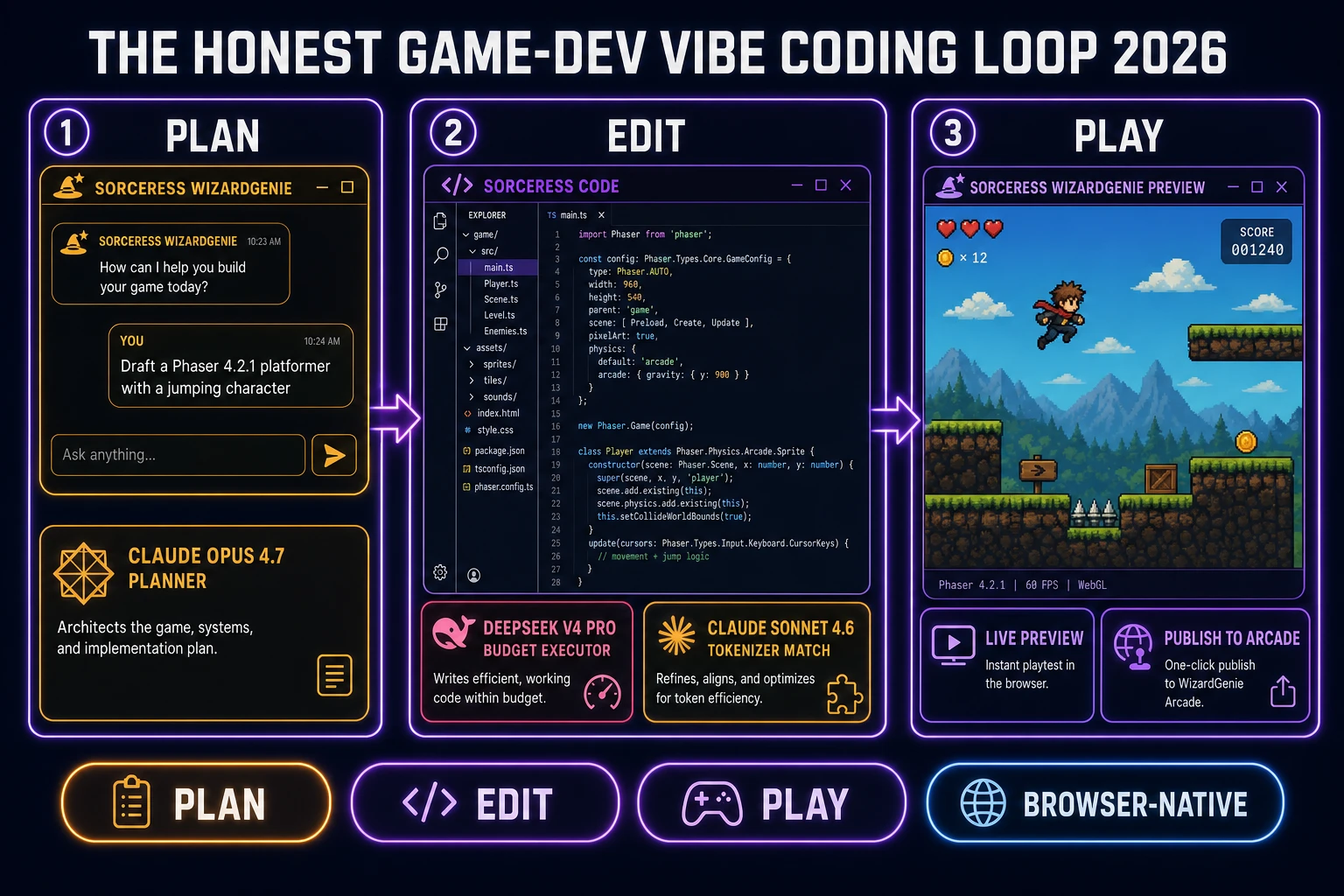
Game development vibe coding workflow diagram with Sorceress WizardGenie as planner Sorceress Code as executor and a live Phaser scene preview
The 2026-09-13 honest game-dev vibe coding loop - WizardGenie plans the scene, Sorceress Code edits the files with a BYO-key executor, and the browser preview renders the running Phaser game live.

What the whole stack costs and the honest indie budget

Adding up the best vibe coding tools as an indie budget for September 2026 lands in three brackets. The zero-budget stack: Sorceress free plan on WizardGenie with BYO Kimi K2.5 free-tier keys (unlimited Instant and Thinking on kimi.com) plus DeepSeek V4 Pro free web chat, Cursor Hobby, Copilot Free, Replit Starter free tier, and Bolt.new Free at 1M tokens per month. Enough to prototype, not enough to iterate to a shippable jam entry inside one weekend.

The $30 per month indie stack: Sorceress $49 Lifetime Early Access (one-time, verified 2026-09-13 in src/app/plans/page.tsx line 51) plus Cursor Pro at $20 plus GitHub Copilot Pro at $10 covers the browser game stack, the local IDE agent, and the completion seat all together. The $75 per month indie stack adds Lovable Pro at $25 for the landing page and playtest signup flow plus one more prompt-to-app slot. The $150 per month studio stack adds Cursor Ultra at $200 (or Cursor Pro Plus at $60) for the heavy-agent workflows on top of the indie stack.

Verified 2026-09-13 across every vendor pricing page cited: the total monthly spend for a full best-vibe-coding-tools stack is bounded at roughly $75 for an indie who wants the browser game stack plus one local IDE plus one prompt-to-app plus one completion seat. That is dramatically less than the pay-every-vendor-at-Ultra-tier interpretation of the category. Pick lanes, not tools.

The verdict for indie game dev in 2026

The honest 2026-09-13 answer for the best vibe coding tools for indie game dev is a three-tool stack: Sorceress WizardGenie plus Sorceress Code plus one generic-side agent (Cursor Pro or Windsurf Pro). WizardGenie owns the browser game loop, Sorceress Code owns the file-aware edits with BYO keys against the 8-model rotation, and Cursor or Windsurf owns the Unity C# or Godot GDScript work that lives on the local filesystem. That stack lands under $50 per month plus the $49 Sorceress Lifetime Early Access one-time, and it covers every game-dev task from a Phaser scaffold to a Unity C# scene to a Vercel-hosted landing page. Every other vibe coding tool named above has a real seat on the chart, but only three of them belong in the daily stack for indie game work in 2026.

For related deep-dives on the model rotation behind these tools, see the sibling piece Chart Best AI Model for Coding (Honest Pick 2026). For the free-tier lanes in detail, see Gauge the Best Free AI Model for Coding (Games Bench 2026). For the prompt-to-game side of the workflow, see Prompt How to Make a Game With AI (Browser Vibe Loop 2026). All three articles cross-reference the same 8-model rotation shipped in the Sorceress Tools Guide.

Frequently Asked Questions

What are the best vibe coding tools in 2026?

As of 2026-09-13, the best vibe coding tools split into four lanes with different prices and different scopes. Browser-native game stack: Sorceress WizardGenie plus Sorceress Code, with BYO-key access to the 8-model rotation (Claude Opus 4.7, Sonnet 4.6, GPT-5.5, Gemini 3.1 Pro, DeepSeek V4 Pro, Kimi K2.5, Grok 4.2, MiniMax M2.7), plus a $49 lifetime option on plans. Local IDE agent: Cursor Pro at $20 per month with unlimited Auto and a $20 model pool, or Windsurf (Devin Desktop) Pro at $20 with daily/weekly quotas. Prompt-to-app: Lovable Pro at $25 per month for 100 credits, or Bolt.new Pro at $25 for 10M tokens, or v0 Plus at $30 per user for $30 in credits. Editor completion: GitHub Copilot Pro at $10 per month for 1,500 AI credits. Replit Core at $20 per month covers the container-plus-agent lane. Every price verified 2026-09-13 against the vendor pricing page.

What is a vibe coding tool actually?

A vibe coding tool is an AI system that turns a plain-English description of what an app should do into working code without the user typing the code themselves. The term was popularized in early 2025 to describe the Cursor / Windsurf / Lovable / Bolt category. In 2026 the definition split into four subcategories: browser-native agents that write and preview code in the same tab (WizardGenie, Bolt.new, Lovable, v0), local IDE agents that edit real files on disk (Cursor, Windsurf, Sorceress Code, GitHub Copilot), prompt-to-app platforms that ship a deploy target with the code (Lovable, Bolt.new, v0), and completion-first extensions that only autocomplete inside an existing editor (GitHub Copilot classic mode). All of them count as 'vibe coding tools' in the SERP sense; the vendor sheet below sorts which one to reach for on which job.

Which vibe coding tool is best specifically for game development?

For game development, the honest 2026-09-13 pick is Sorceress WizardGenie plus Sorceress Code. WizardGenie is the only tool in the category that ships engine-aware idioms for Phaser 4.2.1 (verified 2026-07-09 release), Three.js render loops, and Godot GDScript out of the box, with a dual-agent Planner plus Executor split (verified 2026-09-13 in src/app/wizard-genie/page.tsx) that runs Claude Opus 4.7 as planner and any of Sonnet 4.6, DeepSeek V4 Pro, Kimi K2.5, GPT-5.5, Gemini 3.1 Pro, Grok 4.2, or MiniMax M2.7 as executor. Sorceress Code exposes the same 8-model rotation as a file-aware chat that edits real files with BYO keys (anthropic, deepseek, openai, nvidia) held in localStorage. Cursor and Windsurf are excellent generic IDE agents but do not ship game-engine idioms. Lovable and Bolt.new are excellent prompt-to-app platforms but scaffold web dashboards, not game loops.

How much do vibe coding tools cost in 2026?

Verified 2026-09-13 across vendor pricing pages. GitHub Copilot Pro is the cheapest paid entry at $10 per month for 1,500 AI credits (1,000 base plus 500 flex). Cursor Pro and Windsurf Pro are tied at $20 per month, with Cursor including unlimited Auto plus a $20 frontier model pool and Windsurf including daily and weekly quotas that refresh on their own. Replit Core is also $20 per month with $20 of Agent credits. Lovable Pro is $25 per month for 100 monthly credits plus 5 daily build credits. Bolt.new Pro is $25 per month for approximately 10M tokens. v0 Plus is $30 per user per month with $30 in credits plus $2 per daily login. Cursor Pro Plus is $60, Copilot Pro Plus is $39, Copilot Max is $100, Replit Pro is $100, Cursor Ultra and Windsurf Max are $200. Sorceress ships pay-per-credit with a $49 one-time Lifetime Early Access price point that unlocks the desktop WizardGenie build.

Which vibe coding tool has the best free tier for a game jam?

For a game-jam weekend on 2026-09-13 with no budget, the honest free-tier stack is Sorceress WizardGenie in the browser with BYO Kimi K2.5 free-tier keys (unlimited Instant and Thinking on kimi.com) plus DeepSeek V4 Pro (chat.deepseek.com free web chat), all wired into the Sorceress Code page. Cursor Hobby, Windsurf Free, and Copilot Free all include limited agent quotas but they cap on daily message counts or on model access. Lovable Free gives 5 daily build credits (up to 30 per month) and 20 monthly Cloud credits, which is enough to prototype but not enough to iterate to a jam entry. Bolt.new Free gives 1M tokens per month with a 300K daily cap, which is enough for one small scaffold. v0 Free gives $5 in credits and a 7 message per day cap. Every free tier price verified 2026-09-13 against the vendor page linked in the article body.

Sources

  1. Cursor Models and Pricing
  2. Windsurf (Devin Desktop) Pricing
  3. Lovable Pricing
  4. Bolt.new Tokens and Subscription
  5. v0 by Vercel Pricing
  6. GitHub Copilot Plans and Pricing
  7. Replit Pricing and Plans
  8. Phaser v4.2.1 Giedi Release
  9. Vibe Coding - Wikipedia
Written by Arron R.·2,912 words·13 min read

Related posts