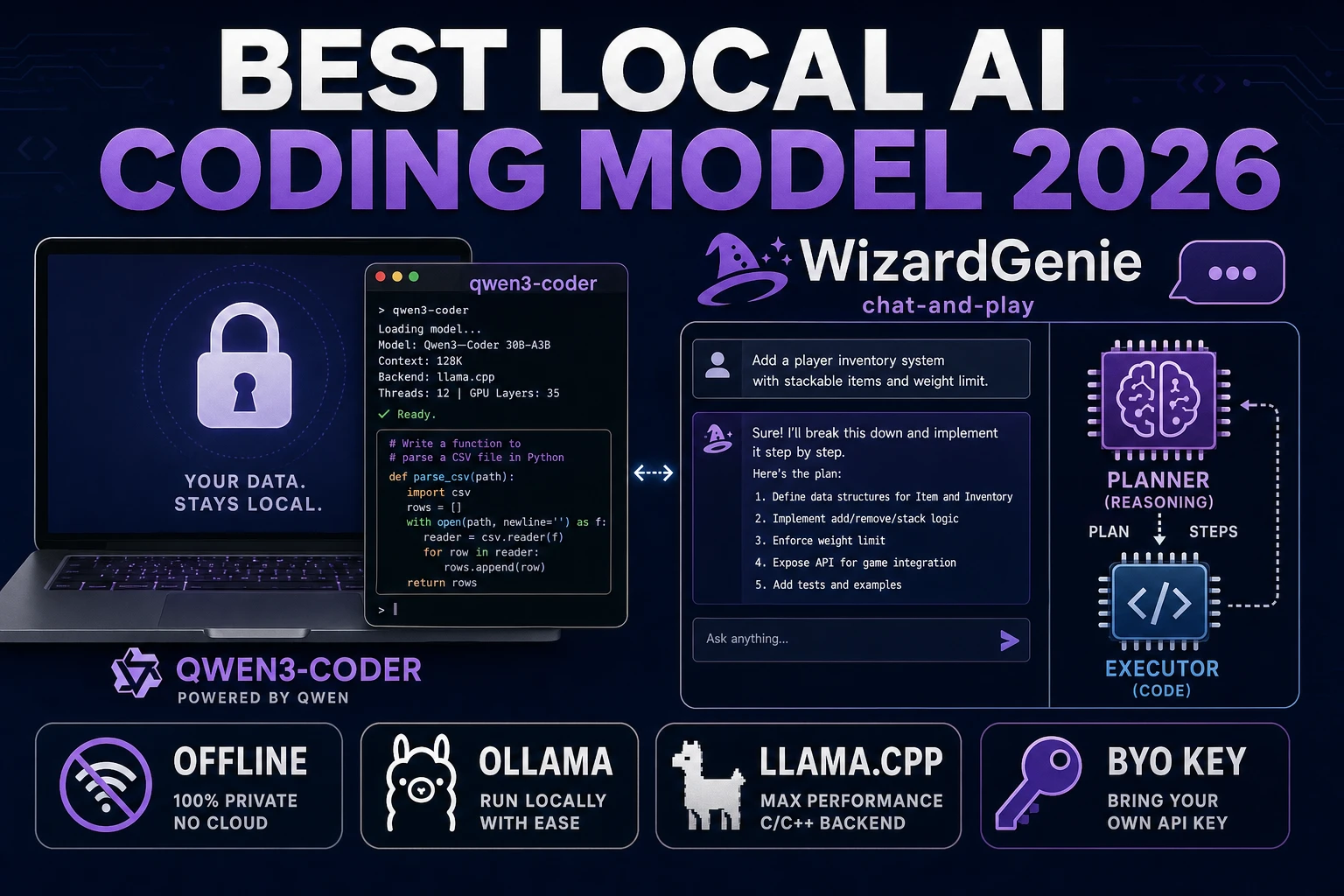
Best Local AI Coding Model (Offline Setup 2026)

By Arron R.9 min read
The best local AI coding model in 2026 is a pairing: qwen3-coder:30b offline via Ollama or llama.cpp for zero-cost typing, plus WizardGenie's BYO-key cheap-clou

Searchers who type best local ai coding model in 2026 usually want one of two very different things: a truly offline runner that never touches the network, or a "logically local" setup where their prompt stays inside their account and their credits do not evaporate on a frontier bill. Both answers are honest, and both are pairings, not single winners. The 2026 recipe on the Sorceress stack is qwen3-coder:30b running offline through Ollama or llama.cpp as the executor - free per token and fully offline - paired with a BYO-key cheap-cloud model inside WizardGenie for the frontier reasoning that will not fit on a consumer GPU. Names below were verified 2026-09-02 against the ollama/ollama library page, the ggml-org/llama.cpp b10760 build tag on GitHub, and the Sorceress Sorceress Code source in src/app/code/page.tsx.
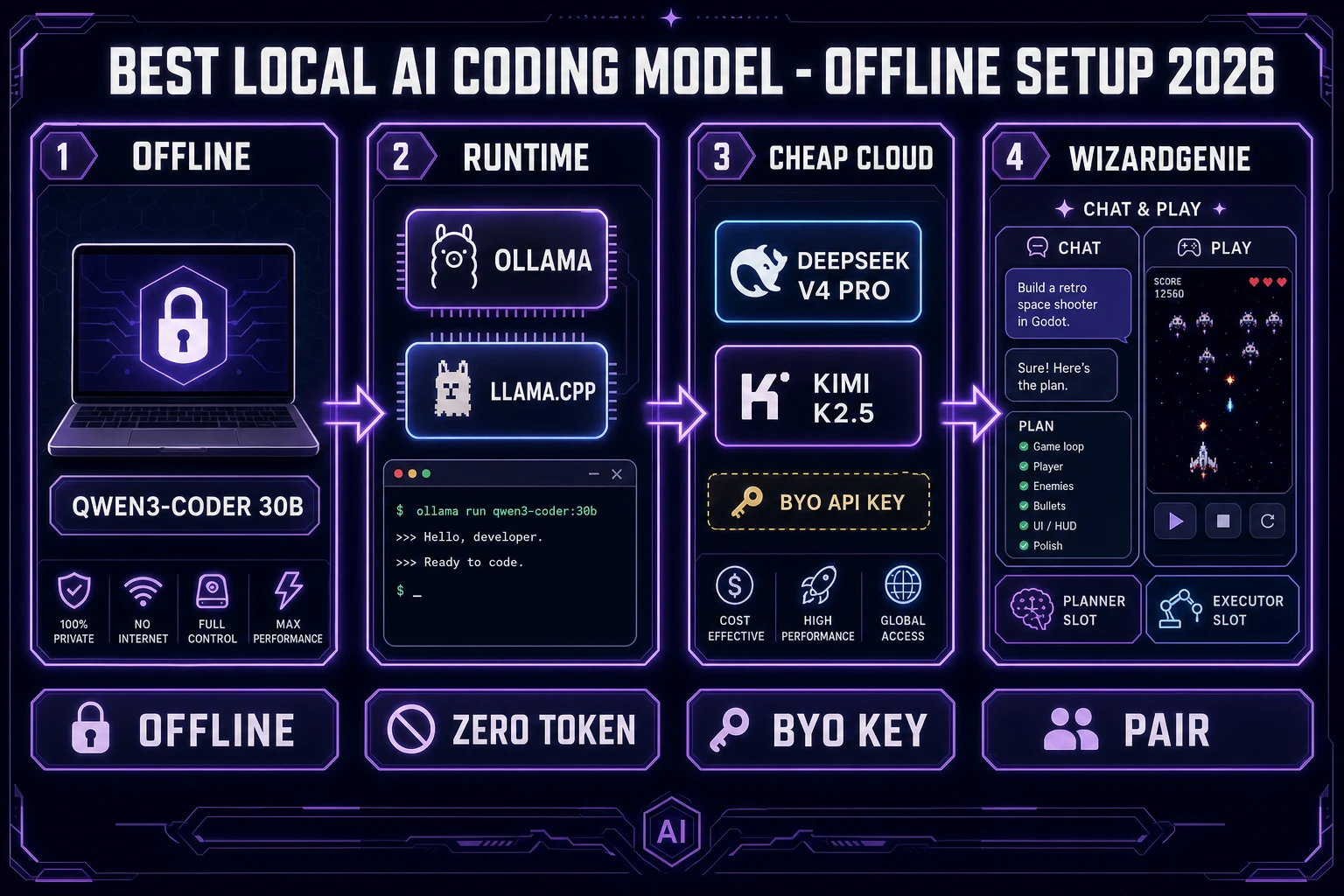
Best local AI coding model 2026 four-panel diagram: offline qwen3-coder 30B, Ollama or llama.cpp runtime, cheap-cloud DeepSeek V4 Pro and Kimi K2.5 BYO key, WizardGenie planner executor split
The 2026 best local ai coding model is a pairing - qwen3-coder:30b offline for zero-token typing, plus BYO-key cheap-cloud reasoning inside WizardGenie for the fixes local memory cannot hold.

What best local ai coding model actually means in 2026

Three overlapping words hide behind the phrase best local ai coding model, and mixing them up costs you a weekend. Offline means the weights live on your machine and the network can be off - typical setup: Ollama or llama.cpp plus an open-weight model like qwen3-coder or gpt-oss. Self-hosted means you run the inference server, but the model may still be a huge open-weight like deepseek-v3.1:671b that only fits on a workstation or a small cluster. Logically local means the code and keys stay inside your own account - typically a BYO-API-key setup like the one in Sorceress Code where anthropic, deepseek, openai, and nvidia keys live only in localStorage and are never sent to Sorceress servers.

Reddit threads on best local ai model reddit conflate all three constantly. The honest 2026 read is: if you want zero per-token cost and full air-gap, use qwen3-coder:30b offline. If you want frontier reasoning on a laptop that cannot host it, use a cheap-cloud BYO-key model. If you want both, run the pair. The rest of this comparison scores that split on real game tasks, not on synthetic SWE benchmarks.

The verdict at a glance

Comparison snapshot as of 2026-09-02. Every row below is verified against a runtime, a model card, or the Sorceress source - not against a leaderboard screenshot.

Dimension Truly offline (qwen3-coder:30b on Ollama or llama.cpp) Cheap-cloud BYO key (DeepSeek V4 Pro / Kimi K2.5 in WizardGenie)
Per-token cost Zero after the download Cheap but non-zero, priced per million tokens
Network requirement None - fully air-gappable Always online
Hardware requirement 24GB VRAM or 32GB Apple Silicon unified memory for 30B Any laptop with a browser tab
Frontier reasoning ceiling Capped at 30B active weights (or 480B if you have the RAM) Higher ceiling via BYO-key frontier providers
Data privacy Never leaves the machine Governed by the vendor's key terms
Best default role Executor - single-variable fixes, HUD text, feel edits Planner - hard scaffolds, architecture bugs, long agent runs

Two lanes, one workflow. Neither lane is the winner by itself. The pairing beats either lane run alone, and the rest of this piece explains why.

The offline best local ai coding model matrix on Ollama in 2026

Names, sizes, and context windows below come straight from the ollama/ollama library entries on 2026-09-02 - not from memory. Pick the row that fits your rig, not the row with the loudest launch post.

Model Params (total / active) Download size Context Best fit
qwen3-coder:30b 30B / 3.3B MoE 19GB 256K native (1M with extrapolation) Default offline executor for game code on a 24GB GPU
qwen3-coder:480b 480B MoE 290GB 256K native Workstations with 250GB+ unified memory - long-horizon coding
gpt-oss:20b 20B Fits a 24GB GPU Standard Reasoning-heavy scaffolds when Qwen falters
gpt-oss:120b 120B Workstation-class Standard Larger open-weight reasoner for local frontier passes
deepseek-v3.1:671b 671B hybrid thinking / non-thinking Workstation-class Standard Alternate offline reasoner when Qwen and gpt-oss disagree
kimi-k2.6 Native multimodal agentic MoE Workstation-class Long Long-horizon coding with vision inputs (screenshots as prompts)
kimi-k2.7-code K2.6 base tuned for code Workstation-class Long Roughly 30 percent fewer thinking tokens than K2.6 on the same tasks
deepseek-coder-v2:16b 16B MoE Consumer-class Standard Legacy coding pick when a Qwen3-Coder download is not possible

qwen3-coder:30b is the default local recommendation because the 3.3B activated MoE routes cheaply enough to type single-variable feel fixes without stalling a 24GB GPU. The 480B sibling is the same architecture at workstation scale - the model card lists a 250GB memory minimum for local inference. gpt-oss:20b (OpenAI's open-weight family listed under the gpt-oss tag) is the honest alternate when the task is reasoning-shaped instead of typing-shaped. Reference for how these MoE families work: the Wikipedia entry on large language models - useful when a teammate asks why 30B / 3.3B beats a dense 13B on the same VRAM.
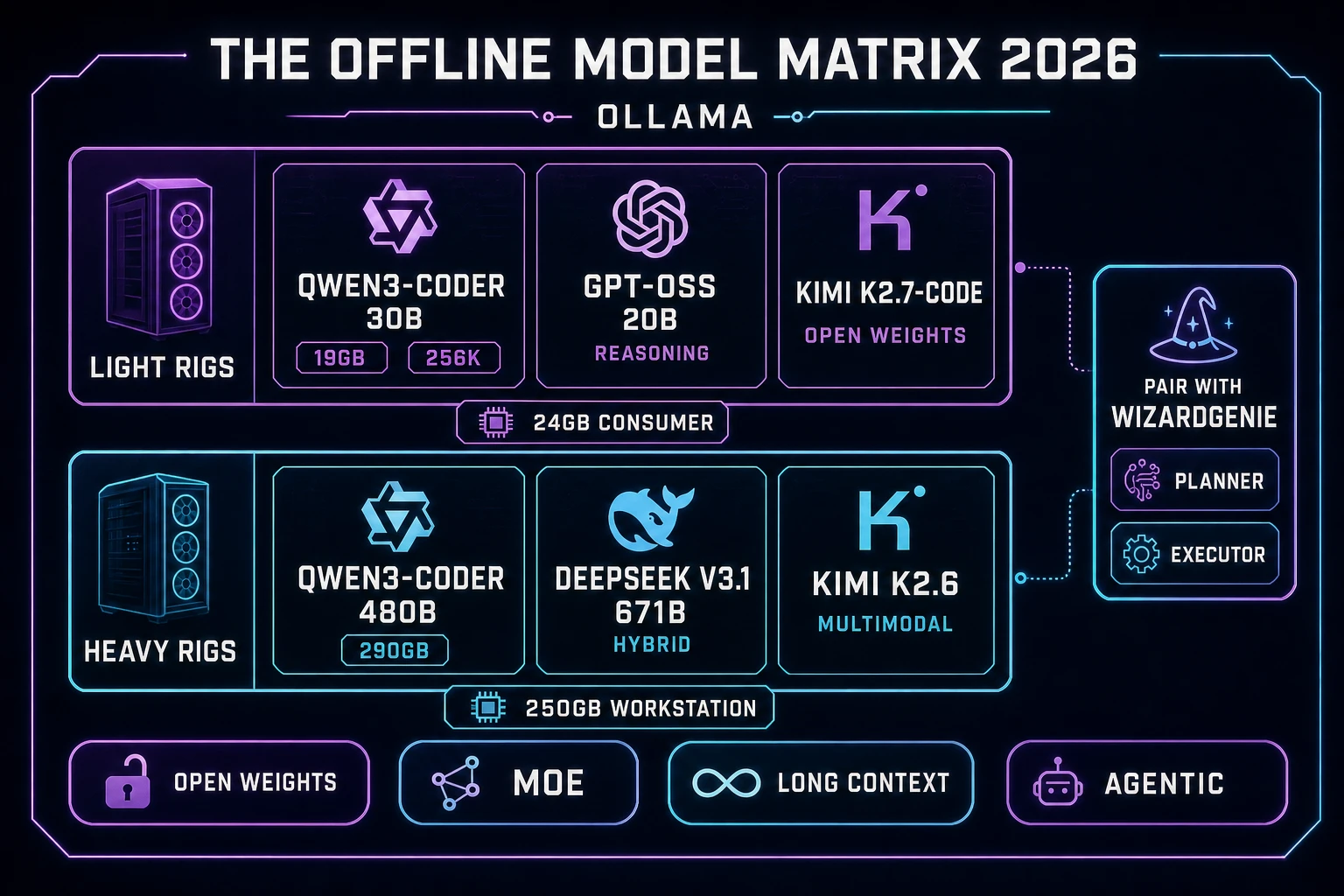
Offline model matrix 2026 diagram showing Qwen3-Coder 30B and 480B, gpt-oss 20B and 120B, DeepSeek V3.1 671B, Kimi K2.6 and K2.7-Code
The 2026 offline coding model matrix: pick the row that fits your VRAM, not the row with the loudest launch reel.

Where a truly offline best local ai coding model wins

The offline best local ai coding model wins the parts of a game jam that are token-cheap and privacy-sensitive. Put qwen3-coder:30b through Ollama or llama.cpp on the executor seat when the task is one of these:

  • Single-variable feel fixes. Enemy speed 90 feels unfair; set to 70; leave the player speed alone. The model never types back a rewritten scene graph because it does not have room to hallucinate one.
  • HUD text and score formatting. Tiny string edits should cost zero cents. A local model is exactly the right tool.
  • Air-gapped iteration on a plane, in a co-op, or under an NDA. The llama.cpp b10760 build (released 2026-09-02) ships CPU and GPU builds for macOS Apple Silicon, Ubuntu, Windows CUDA 12/13, ROCm 7.14, Vulkan, Metal, OpenVINO, SYCL, and Android arm64. If a platform runs code, it can run this runtime.
  • Retest scripts and pass/fail logging. Ask the local executor to walk the five game-task scorecard rows from the weigh the best ai coding model post and print a Markdown table. That is a typing task, not a reasoning task, and the local model handles it for free.

Local also wins on latency for feel edits. Once the model is warm in VRAM, a two-line HUD tweak returns before a cloud round-trip finishes handshaking. That matters when you are trying to iterate on jump curves at 3 a.m. and the router in your co-op is not helping.

Where a cheap-cloud API beats the best local ai coding model

Frontier reasoning has a ceiling that a 30B local executor cannot break. The Sorceress catalog exposes cheap-cloud budget executors that beat the best local ai coding model on genuinely hard tasks:

  1. Hard scaffolds with strict instruction-following. The full Sorceress CODING_MODELS lineup in src/app/_home-v2/_data/tools.ts - Claude Opus 4.7, Claude Sonnet 4.6, GPT-5.5, Gemini 3.1 Pro, DeepSeek V4 Pro, Kimi K2.5, Grok 4.2, MiniMax M2.7 - reaches reasoning quality that no consumer-scale open weight matches. If you need a one-shot planner for a whole game skeleton, cheap-cloud wins.
  2. Long agent runs. Grok 4.2 exposes a 2M-token context; Gemini 3.1 Pro exposes 1M; Kimi K2.5 exposes 256K optimized for coding. A local 30B running on a 24GB card cannot hold that much state in practice.
  3. Cross-file bug hunts. When a bug spans three files and a config, a frontier reasoner spots the interaction in one pass. Local models tend to fix the symptom in the file they were shown.
  4. Weekend one-off jams where you do not want to babysit a runtime. Opening WizardGenie in a browser and pasting a DeepSeek key beats fighting driver versions to make a 30B fit at 3 a.m.

DeepSeek V4 Pro and Kimi K2.5 are the two catalog picks that carry the "cheap" tag - Budget and 256K coding respectively. Both are BYO-key friendly through Sorceress Code, which stores keys only in localStorage. If you already have a DeepSeek or NVIDIA account (Kimi K2.5 is exposed via NVIDIA NIM in the /code page), the cheap-cloud lane is one paste away.

Pick offline if / Pick cheap-cloud if

Two short scenario lists. Match yours; do not overthink.

Pick a truly offline model if:

  • You own a 24GB (or larger) consumer GPU or a 32GB+ Apple Silicon machine.
  • Your project is under an NDA, an air-gap, or a strict data-residency rule.
  • You spend most of your weekend on single-variable fixes and HUD polish, not architecture.
  • Your credits budget is genuinely zero and you own the power cost anyway.

Pick a cheap-cloud BYO-key model if:

  • Your laptop has less than 24GB of VRAM or unified memory.
  • Your project needs frontier reasoning at least once per session (a fresh scaffold, a hard bug that spans three files).
  • You do not want to maintain a local runtime, drivers, or a 19GB download.
  • Your data is not under an air-gap requirement and your keys are yours to spend.
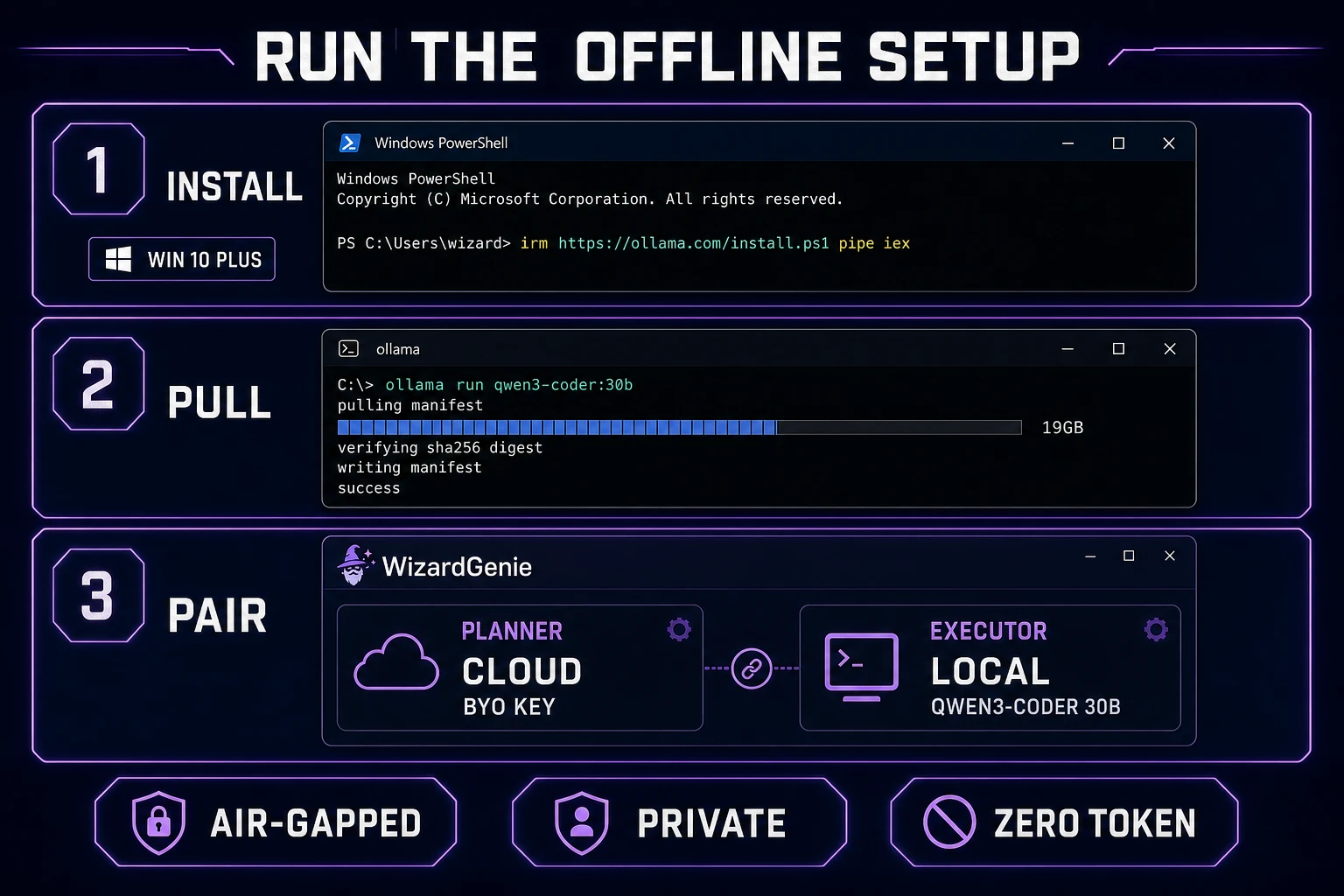
Offline setup diagram showing PowerShell Ollama install, ollama run qwen3-coder 30B pull, and WizardGenie planner cloud plus executor local pairing
The offline setup: install Ollama, pull qwen3-coder:30b, wire the pair inside WizardGenie so the planner is cheap-cloud and the executor is local.

Run the offline best local ai coding model setup

Ollama is the fastest way to a working offline coder in 2026. Windows 10 or later, one PowerShell line:

irm https://ollama.com/install.ps1 | iex

macOS and Linux have parallel installers on the official download page and on the ollama/ollama repository (179,976 stars as of 2026-09-02). Pull the default coding model:

ollama run qwen3-coder:30b

That downloads roughly 19GB and drops you into an interactive REPL. Point any OpenAI-compatible client at http://localhost:11434/v1 to reach the same model programmatically. If you prefer a lower-level runtime, grab the b10760 build tag of llama.cpp for your platform (CUDA 12/13, ROCm 7.14, Vulkan, Metal, OpenVINO, SYCL, CPU, or Android arm64) and load a GGUF quant of qwen3-coder or gpt-oss directly.

Two honest sizing notes: qwen3-coder:30b at Q4 fits a 24GB GPU with room for a 32K working context; the 480B variant needs 250GB or more of unified memory per the model card. If a game project needs the 480B lane and you do not own that rig, use the cheap-cloud lane instead - do not force a swap-thrashed local run.

Pair the local model with WizardGenie for the best local ai coding model workflow

The pairing is where the recipe pays off. WizardGenie is the Sorceress AI-native game engine - it drives the eight cheap-cloud coding models in the CODING_MODELS catalog and hosts the play surface for your prototype. Sorceress does not run Ollama directly today (verified 2026-09-02 in src/app/code/page.tsx - BYO API keys cover anthropic, deepseek, openai, and nvidia, and the localhost:8080 server is a filesystem bridge, not an LLM runtime). The honest 2026 pattern is a split brain:

  1. Planner seat: cheap-cloud BYO key inside WizardGenie. Paste a DeepSeek V4 Pro key or select Kimi K2.5 via NVIDIA. Ask it to draft the one-screen slice, plan the task list, and write the next executor prompt.
  2. Executor seat: local qwen3-coder:30b via Ollama. Copy the planner's prompt into your terminal or into any OpenAI-compatible IDE pointed at localhost:11434. Let the local model type the actual gravity, hitbox, and score edits.
  3. Retest loop. Ask the local executor to score the five game-task rows from the pit the best ai for Godot scorecard and print pass/fail. Feed real fails back to the planner. Do not burn frontier tokens on feel edits.
  4. Budget floor. Read the current tool credits and lifetime pricing on the Sorceress plans page. A Lifetime Early Access account covers desktop WizardGenie with auto-update while your local runtime handles the executor half for free.

Verdict, holding steady on 2026-09-02: the best local ai coding model for a real game jam is not a single row on a leaderboard. It is qwen3-coder:30b offline through Ollama or llama.cpp on the executor seat, paired with a cheap-cloud BYO-key model (DeepSeek V4 Pro or Kimi K2.5) on the planner seat inside WizardGenie. Retest the pair after every model or runtime bump - the MDN web games loop of input, update, render is the only surface that will actually tell you which local model is winning your project this week.

Frequently Asked Questions

What is the best local AI coding model in 2026?

For consumer hardware in 2026 the best local AI coding model is qwen3-coder:30b, verified 2026-09-02 on the ollama/ollama library page. It weighs about 19GB, offers 30B total parameters with only 3.3B activated per token, natively supports a 256K context window (up to 1M with extrapolation), and was trained on 7.5T tokens with a 70 percent code ratio. If you have 250GB or more of unified memory, qwen3-coder:480b is the full-fat sibling. Pair either one with WizardGenie for a cheap-cloud planner when a task is bigger than local memory can hold.

Do I need a GPU to run a local AI coding model offline?

No, but a GPU is strongly preferred. llama.cpp build b10760 (released 2026-09-02) ships CPU builds for Ubuntu, macOS, Windows, and Android arm64, plus GPU builds for CUDA 12/13, ROCm 7.14, Vulkan, OpenVINO, SYCL, Metal (via xcframework), and OpenCL Adreno. A 30B MoE like qwen3-coder:30b runs on a 24GB consumer GPU or on Apple Silicon with 32GB of unified memory. Pure CPU works but is slow enough that only the executor role (single-variable fixes, HUD copy) is worth burning offline.

Which local coding model works for games specifically?

qwen3-coder:30b is the top general pick for game code because its 3.3B activated MoE routes cheaply enough to run micro fixes (gravity, hitboxes, score) without stalling. gpt-oss:20b (OpenAI's open-weight family, 20B and 120B tags on ollama) is a solid alternate for reasoning-heavy scaffolds. For larger rigs, deepseek-v3.1 (671B hybrid thinking / non-thinking) and kimi-k2.6 (open-weight multimodal agentic) both handle long-horizon coding well. Test on your specific engine (Phaser, Godot, Pygame) before locking in a default.

Is a local model actually cheaper than DeepSeek V4 Pro over a full weekend jam?

Yes on per-token spend, no on hardware amortization. Once qwen3-coder:30b is downloaded, every subsequent completion is free at the model layer - only power and hardware wear cost money. A cheap-cloud DeepSeek V4 Pro call still bills tokens each time. But if you already own a capable GPU or a Mac with 32GB+ unified memory, the offline model wins the per-jam bill outright. If you do not own the hardware, a BYO-key setup inside WizardGenie is the honest cheaper path.

Can Sorceress WizardGenie or the /code page run an Ollama model directly?

Not as of 2026-09-02 - verified against src/app/code/page.tsx in the Sorceress source. The /code page carries BYO-API-key slots for anthropic, deepseek, openai, and nvidia providers, storing keys only in localStorage. The Sorceress local server URL (default http://localhost:8080) is a filesystem bridge for local projects, not a local LLM runtime. Run Ollama or llama.cpp separately for the offline pass, then flip to WizardGenie's BYO-key models when a task needs frontier reasoning.

Sources

  1. ollama/ollama - GitHub
  2. ggml-org/llama.cpp - GitHub
  3. Large language model - Wikipedia
  4. Games - MDN Web Docs
Written by Arron R.·2,011 words·9 min read

Related posts