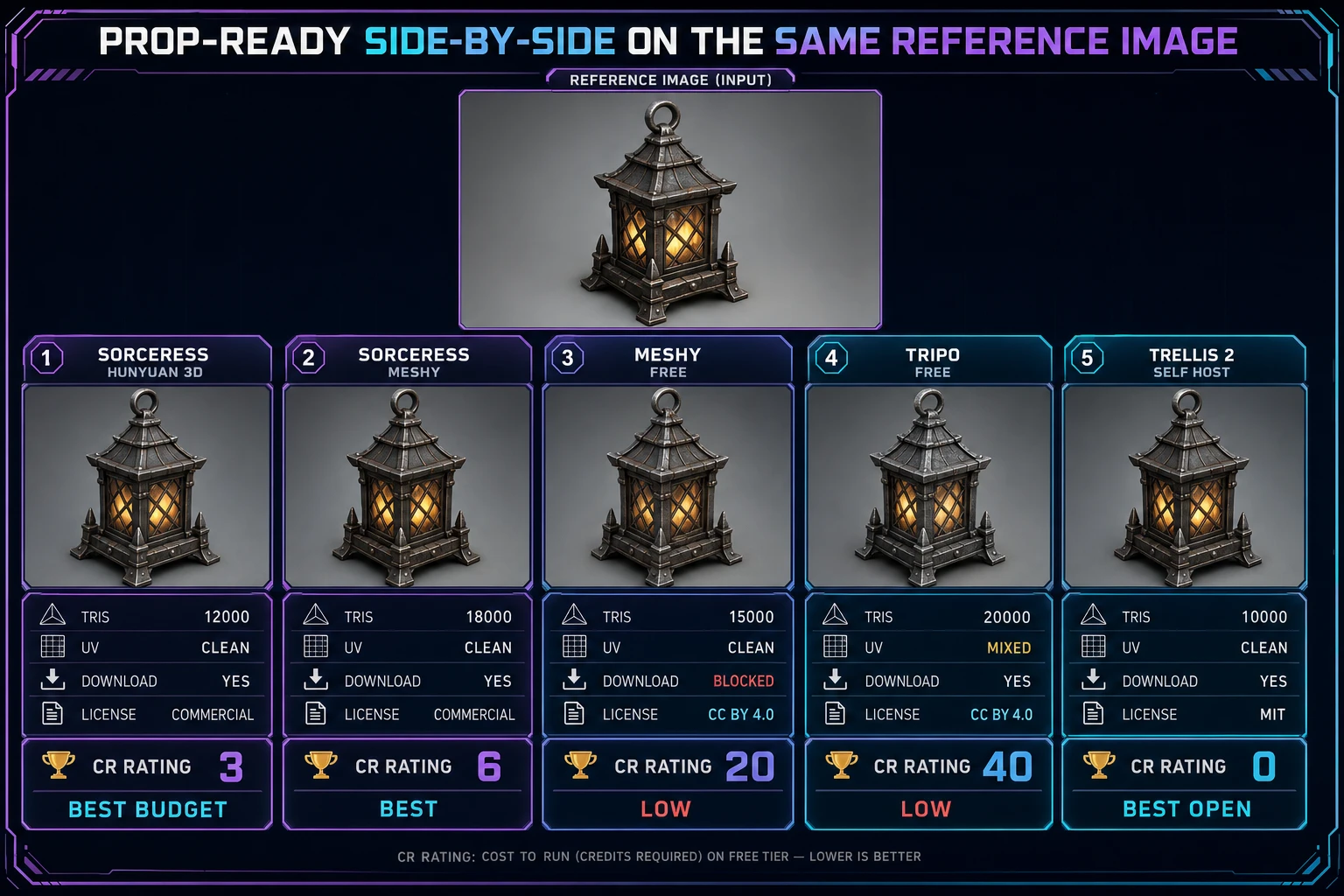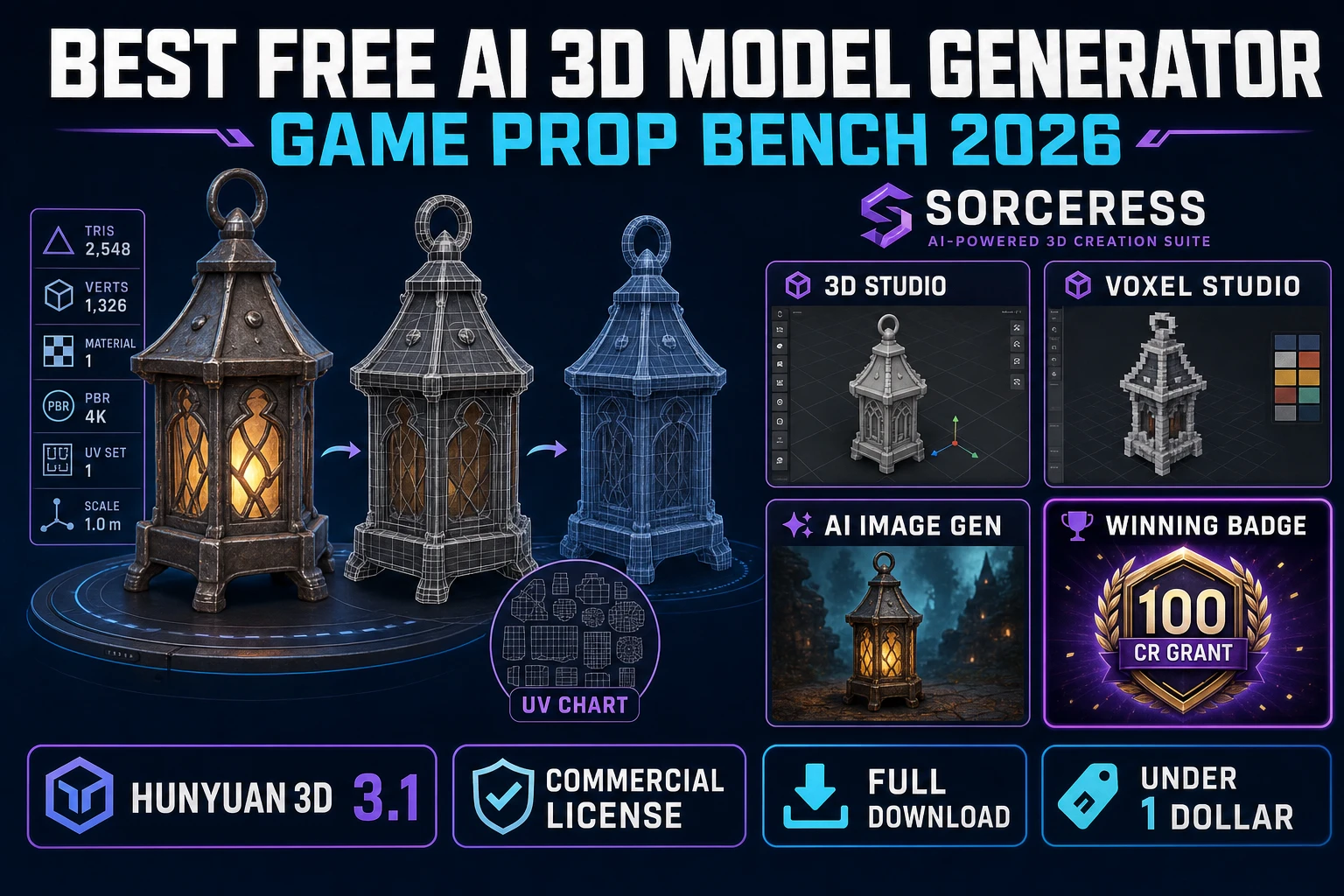
The phrase "best free ai 3d model generator" is a promise that rarely survives contact with a real game project. Most searches land on marketing pages that quietly redefine "free" - a monthly credit cap that runs out on day three, a viewer that will not export the model, a commercial license that requires attribution on your Steam page, or a self-hosted repo that assumes you own a 24 GB NVIDIA workstation. The honest question for a game dev on a jam weekend is not "which tool ships for zero dollars" - every tool ships a free tier now - but "which tool ships a downloadable, commercial-licensed, game-ready GLB inside 72 hours from a browser tab I can open right now." This article benches every credible best free ai 3d model generator on that exact question, using the same lantern prop reference image through five different free-tier pipelines, and grades each on the game-prop bar: clean topology under 20K triangles, a single UV chart, a baked texture, a 2K to 4K PBR material set, a full GLB download, and a commercial-use license. The verdict, verified against every vendor's public terms on the day of writing and against the Sorceress 3D Studio source, is that Sorceress 3D Studio's 100-credit signup grant is the free tier that clears the bar with headroom - and this article walks through why, tool by tool, credit by credit.
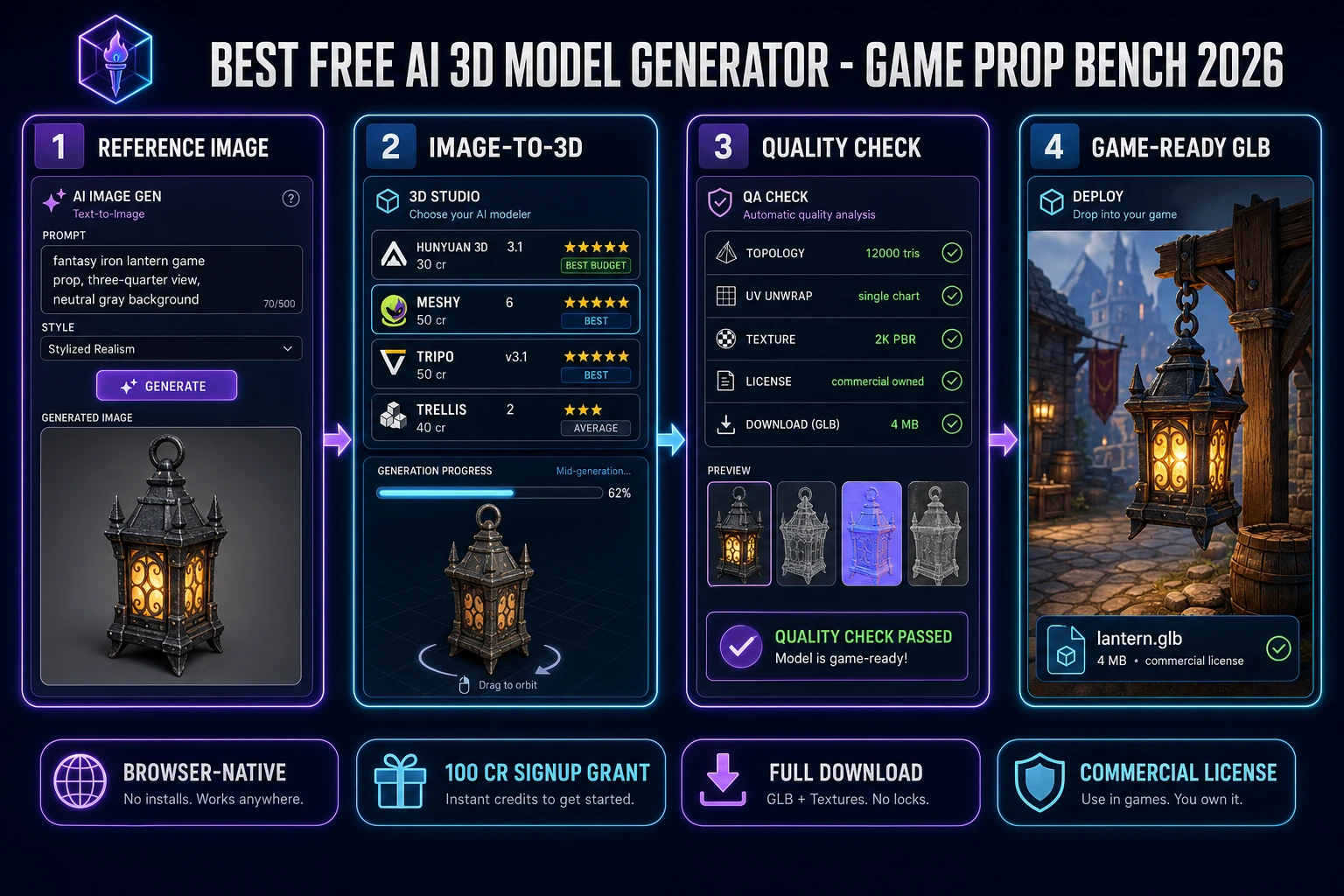
What "best free ai 3d model generator" actually means for game devs in 2026
A game dev searching for the best free ai 3d model generator in 2026 has a specific deliverable in mind: a textured polygon mesh, packaged as a GLB or FBX file, that can be dropped into Unity, Unreal, Godot, or a Three.js scene and rendered inside a shipping game. That output primitive is the same one traditional 3D artists deliver after days of ZBrush sculpting, retopology, UV unwrapping, and texturing - only the AI generator collapses the timeline to a few minutes per prop. The trap for a searcher is that "free" attaches to at least four different pricing shapes in the 2026 market, and every shape hides a different cost:
- Fully free and open-source - the code and weights are downloadable under a permissive license (MIT, Apache, CC0), you self-host on your own GPU, and there are no per-run costs. Microsoft TRELLIS and Tencent Hunyuan 3D 2.1 are the two credible options in this shape (verified 2026-09-01 against github.com/microsoft/TRELLIS.2 and github.com/Tencent-Hunyuan/Hunyuan3D-2.1). The hidden cost is compute: 16 to 24 GB of NVIDIA GPU VRAM plus a working CUDA 12.4 environment.
- Freemium with a monthly credit cap - the hosted tool ships a small monthly credit allowance that resets on the first of the month. Meshy Free ships 100 credits per month, Tripo Free ships 300 credits per month (verified 2026-09-01 against each vendor's public pricing documentation). The hidden cost is the cap itself and, in Meshy's case, a blocked-download restriction on the free tier that keeps the generated model inside the vendor's viewer.
- Trial credits at signup - a one-time credit grant when you create the account, with no monthly reset. Sorceress 3D Studio ships a 100-credit starter grant that funds around three Hunyuan 3D 3.1 hero props with full commercial ownership and immediate GLB download (verified 2026-09-01 in
src/lib/threed-models.ts). - Freemium with a non-commercial license - the free tier permits generation but restricts commercial use, usually via a Creative Commons Attribution 4.0 (CC BY 4.0) license (verified 2026-09-01). Meshy Free and Tripo Free both use CC BY 4.0 on outputs. That is not "free" if the game ever goes on sale on Steam - it becomes a paid tool the moment you monetize.
The best free ai 3d model generator for a game jam is the tool whose "free" pricing shape survives all three game-prop requirements simultaneously: generate (the model has to actually run), download (the GLB has to reach your local file system), and ship (the license has to permit commercial distribution of the finished game without attribution obligations on every marketing surface). Very few free tiers clear all three at once, which is the whole reason a bench like this article exists.
The three ways free tools charge you (credit caps, watermarks, retention)
Every hosted free tier in 2026 charges its users in one of three ways, none of them a per-run dollar cost. Understanding which trade a given tool makes is the difference between three usable props and zero.
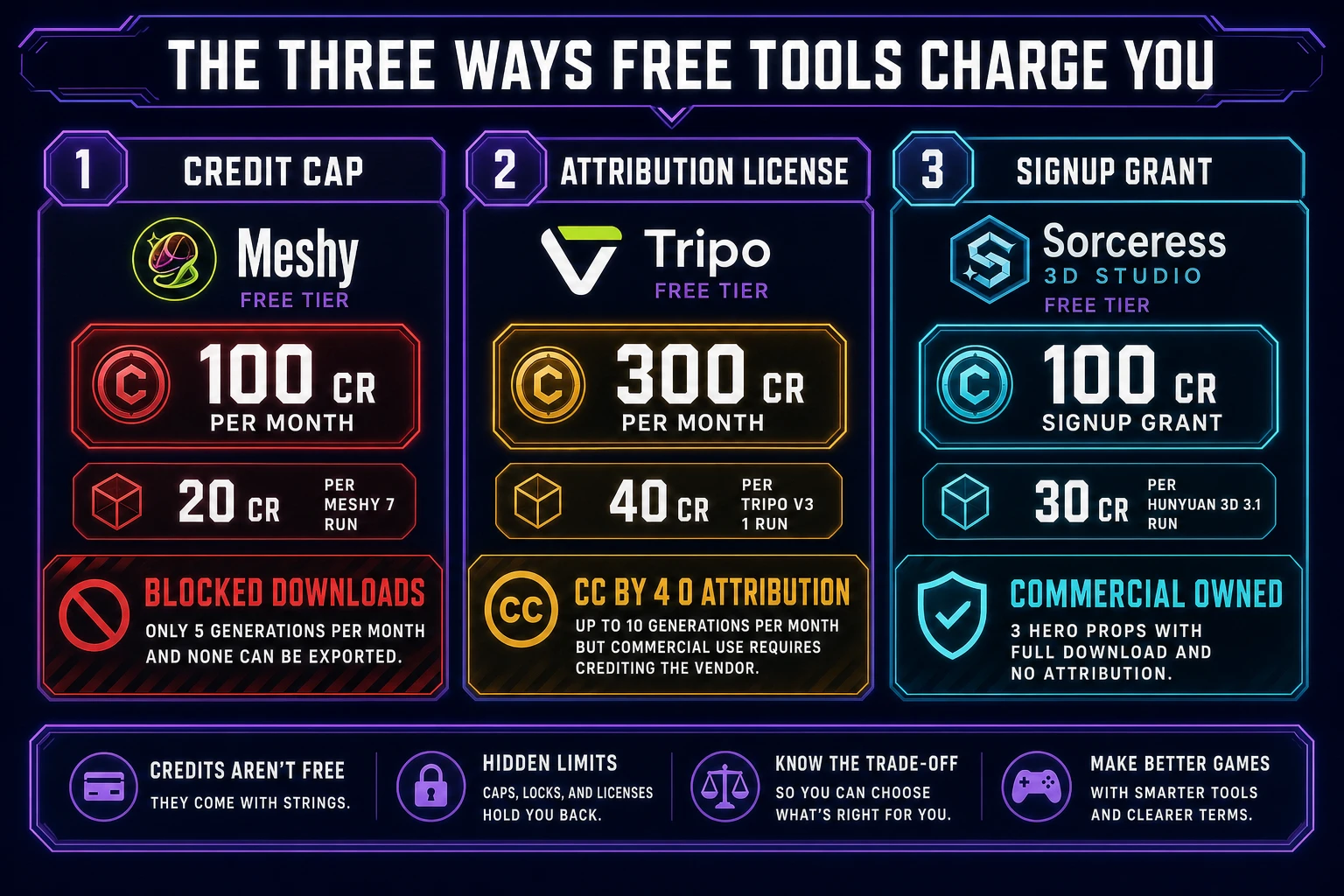
The first charge is the monthly credit cap. Meshy Free ships 100 credits per month that reset at 00:00 UTC on the first of each month, and every Meshy 7 image-to-3D generation costs 20 credits (verified 2026-09-01 against Meshy's public pricing documentation). That is a hard ceiling of five image-to-3D generations per month per account. Tripo Free ships 300 credits per month, with Tripo v3.1 image-to-3D at roughly 30 to 40 credits per generation for a standard texture, giving about seven to ten monthly generations. Both caps are useful for evaluation, unusable for a production roster.
The second charge is the download or retention restriction. Meshy Free explicitly blocks model downloads on its free plan - the generated 3D asset lives inside Meshy's web viewer and cannot be exported to a local GLB or FBX file (verified 2026-09-01 against Meshy's public plan comparison). Free-plan Meshy 5 outputs get a limited download quota (about 10 per month), but Meshy 6 and Meshy 7 generations - the higher-quality models most searchers actually want - are viewer-only until you upgrade. That single restriction is disqualifying for a game jam: if the GLB never leaves the vendor's browser, it never reaches your game engine.
The third charge is the license restriction, and this is the one that catches game devs most often because it is invisible until the game goes on sale. Meshy Free output is licensed under CC BY 4.0, which permits commercial use but requires attribution to Meshy in the commercial page description (verified 2026-09-01 against Meshy's public terms of use). Tripo Free output is also licensed under CC BY 4.0 and is public by default (visible on Tripo's community feed), so any prop generated on Tripo Free is technically visible to other users and must credit Tripo on any commercial release page. Some marketplaces (itch.io hobbyist projects, small Steam indie games) accommodate CC BY attribution without friction; others (publisher-distributed console releases, work-for-hire client projects) do not. The safe assumption is that any attribution obligation is a legal-review cost that a free tier is silently loading onto the game before it ships.
A truly free open-source tool - Microsoft TRELLIS 2 under the MIT License, or Tencent Hunyuan 3D 2.1 under its open-source framework release - collapses all three charges to zero on the model output, at the cost of a self-hosting compute burden. The TRELLIS 2 GitHub repo (verified 2026-09-01) lists a 24 GB NVIDIA GPU requirement with CUDA Toolkit 12.4 on Linux; the Hunyuan3D-2.1 repo ships a 3.3 B parameter shape model plus a 2 B parameter paint model with full PBR support. Both are genuinely free to run in perpetuity if the GPU is on hand.
Sorceress 3D Studio - the browser best free ai 3d model generator tier and what it produces
Sorceress 3D Studio takes a fourth pricing shape - the one-time signup grant - and it happens to be the shape that most cleanly clears the three game-jam requirements without any hidden charge. When a new account is created, the Sorceress starter grant deposits 100 credits into the account balance with no expiration and no monthly reset, and the Sorceress credit rate is 100 credits per US dollar (verified 2026-09-01 against CREDITS_PER_DOLLAR in src/lib/models.ts line 69). Every credit spent generates output that the user commercially owns, no attribution required, and every generation ships a full GLB download the instant it completes.
Inside 3D Studio the model picker for image-to-3D generation in 2026 (verified 2026-09-01 in src/lib/threed-models.ts) exposes seven bookable free-and-paid models plus a VIP-only free-unlimited tier:
- Hunyuan 3D 3.1 at 30 credits per run, rated Best Budget. The prop-generation workhorse for a free-tier budget - the 100-credit grant funds three full runs.
- Meshy 7 at 50 credits per run (35 base + 15 texture), rated Best. Two runs fit inside the grant with no headroom.
- Meshy 6 at 50 credits per run, rated Best. Same math as Meshy 7 - two runs on the grant.
- Tripo v3.1 at 50 credits image-to-3D with HD texture (40 credits at standard texture), rated Best. One HD run plus one standard run fits inside the grant with 10 credits left.
- TRELLIS 2 at 40 credits at 1024p default (35 credits at 512p, 45 credits at 1536p), rated Average in the picker. Two runs on the grant, no headroom.
- Rodin 2.0 (Hyper3D Gen-2) at 50 credits, rated Average. Two runs on the grant.
- Tripo Smart Mesh P1 at 65 credits image-to-3D, low-poly specialist. One run on the grant.
- Tripo P2 Preview at 125 credits (film-grade quad topology). Exceeds the grant - upgrade required.
The picker also ships Pixal3D as a free-unlimited option for VIP-tier members (locked with an upsell for everyone else). For a first-time best free ai 3d model generator run against the 100-credit signup grant, the cleanest budget is three Hunyuan 3D 3.1 hero props at 90 credits total, leaving 10 credits for a concept image pass through AI Image Gen at 8 credits per generation with GPT Image 2 or Nano Banana Pro (both included in the unified image gen panel, verified 2026-09-01 in src/app/_home-v2/_data/tools.ts). For voxel-style props (Minecraft-block aesthetic instead of smooth topology), Voxel Studio is the sibling tool with a matching free-tier pipeline that operates on the same signup grant credits.