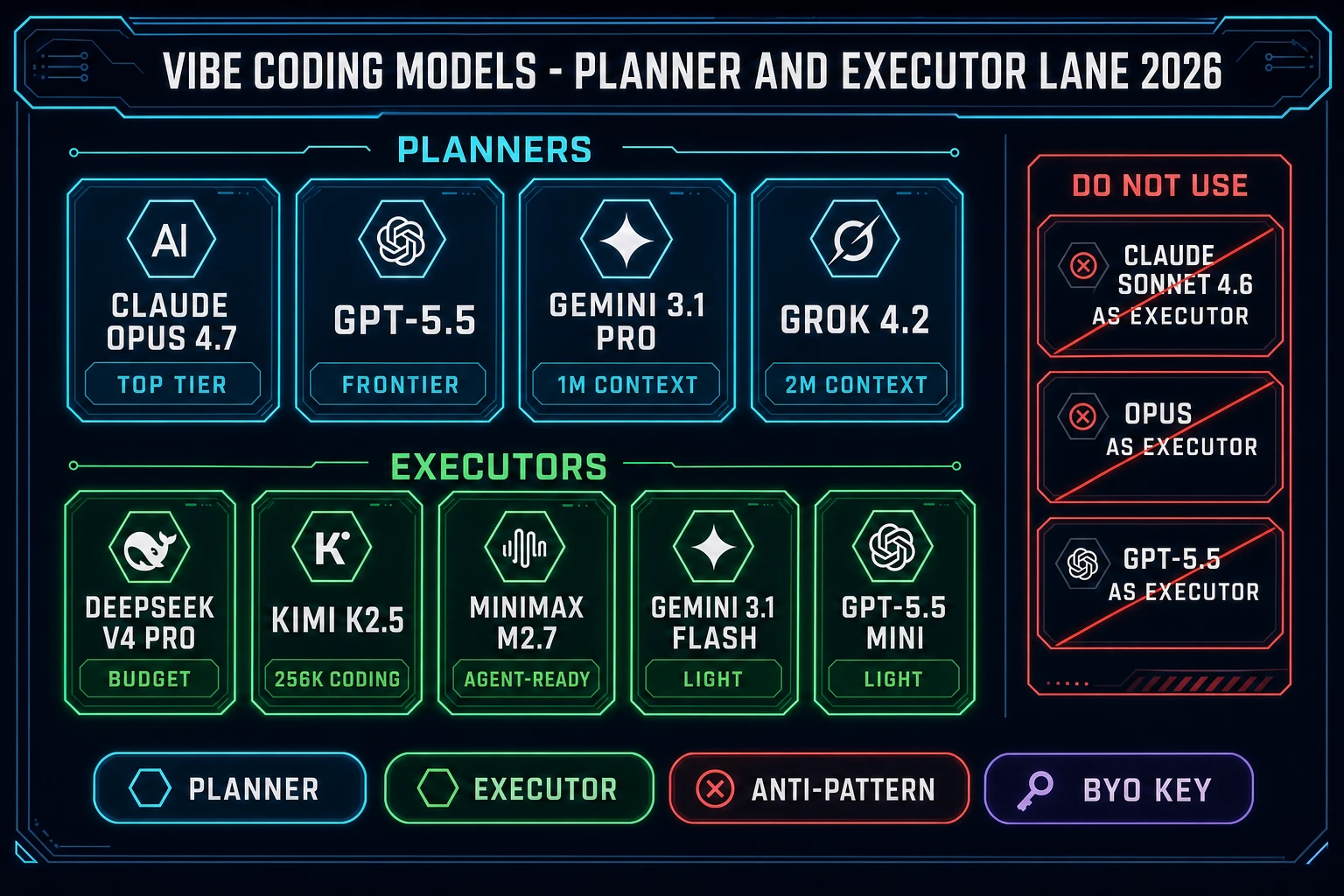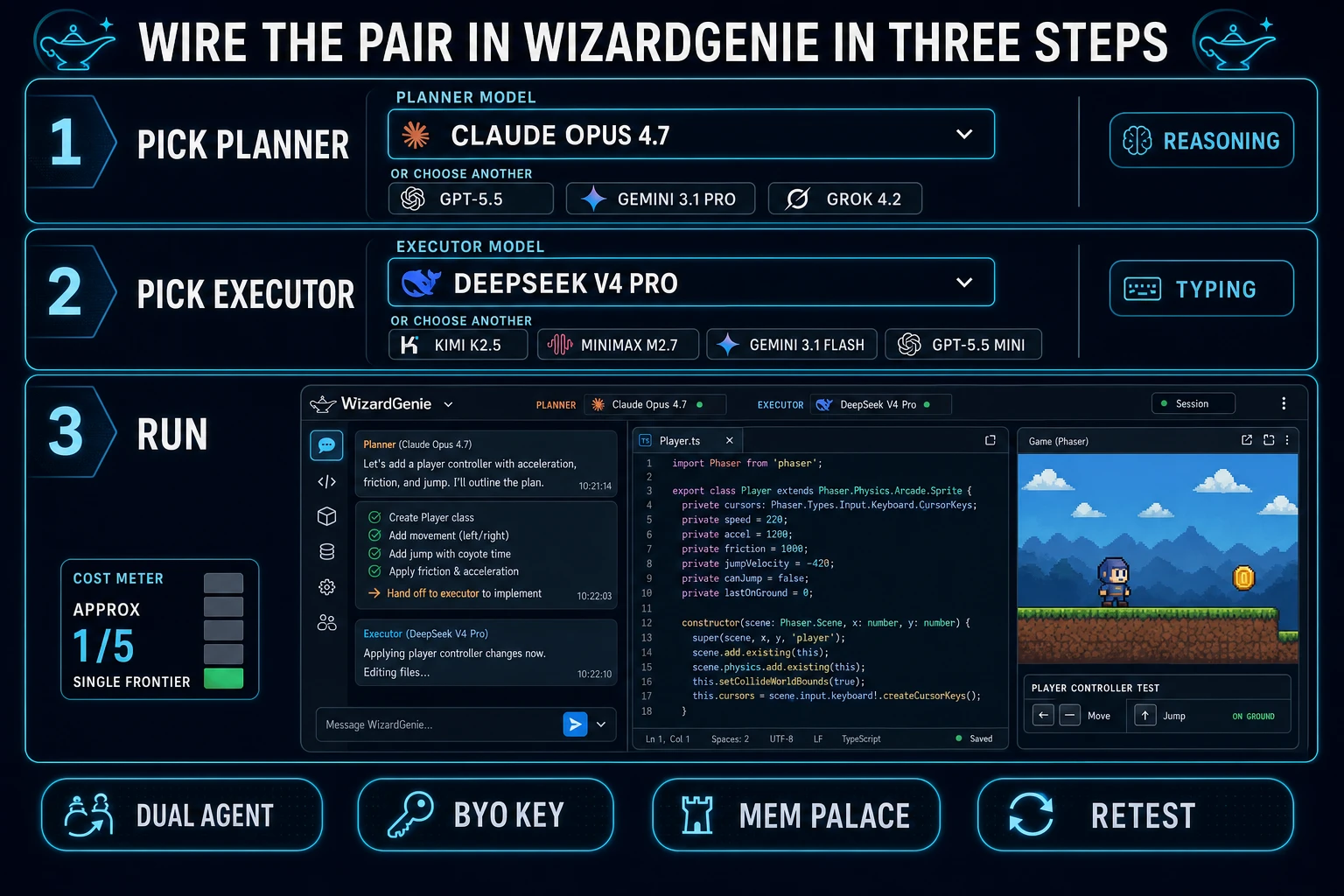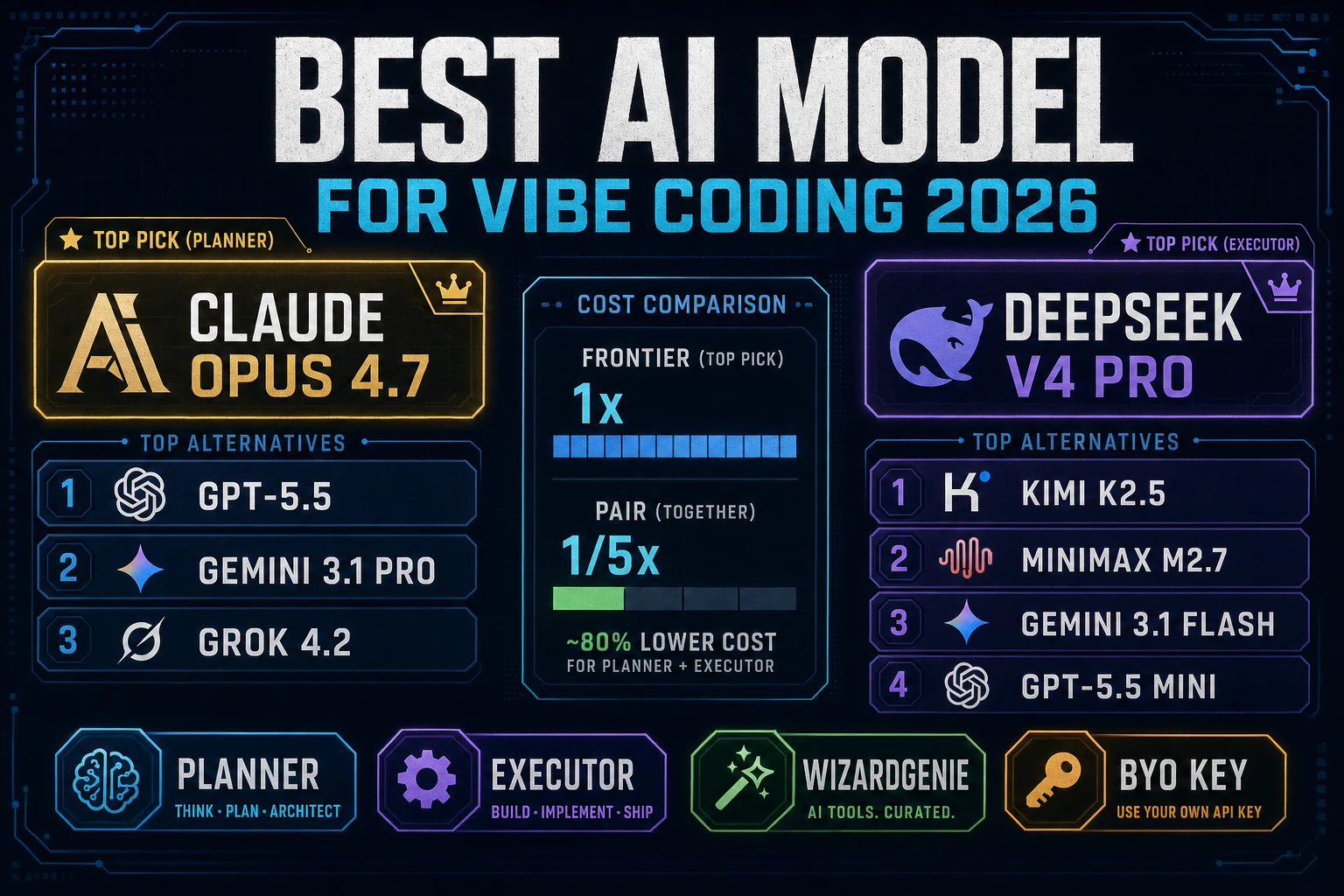
Searchers who type best ai model for vibe coding in 2026 want a single winner, and the honest 2026 answer refuses to give one. Vibe coding at scale is a two-agent shape: a top-tier reasoner reads the spec once, and a genuinely cheap fast typer does the 90 percent of tokens that follow. Names that matter, verified 2026-09-04 against the CODING_MODELS list in src/app/_home-v2/_data/tools.ts. Planner seat: Claude Opus 4.7, GPT-5.5, Gemini 3.1 Pro (1M context), Grok 4.2 (2M context). Executor seat: DeepSeek V4 Pro (Budget tag), Kimi K2.5 (256K coding tag), MiniMax M2.7 (Agent-ready tag), plus the light-tier siblings Gemini 3.1 Flash and GPT-5.5 Mini. Pair one from each row inside WizardGenie and the run bill drops to roughly one-fifth of a single-frontier setup for the same weekend build.
What best ai model for vibe coding actually means in 2026
Vibe coding is the pattern where a developer speaks a game or app into being through natural language, iterates in seconds, and stops treating raw code as the primary artifact. That definition sounds soft, but the engineering under it is exact - a software agent loop of read spec, plan tasks, write file, run build, read log, patch file, loop again. The single-model version of that loop is expensive and slow. The Planner + Executor version is cheap and fast, and it maps cleanly onto the way modern large language models price their reasoning against their typing.
The best ai model for vibe coding in 2026 is therefore a two-name answer. The Planner reads the one-page spec, plans the task list, and writes the follow-up prompts - it is called maybe five to twenty times over a weekend project and its per-call token count stays low. The Executor writes every file, every patch, every retry - it is called two hundred times and burns 90 percent of the tokens. On that split the vendor prices matter in only one place: the executor row. Pay frontier rates there and the run bill roughly quintuples for zero measurable quality gain on straight typing. That is the whole thesis - and the reason the full best ai coding model bench and the best local ai coding model writeup both land on pairings, not on single winners.
The Planner + Executor economics in one minute
Two lanes, one bill. The Planner burns reasoning tokens - the expensive kind - but at low volume. The Executor burns typing tokens - the cheap kind - at very high volume. Multiply low-volume expensive by high-volume cheap and the total lives inside the cheap column. Multiply high-volume expensive by high-volume expensive and the total lives on your credit card.
A concrete session profile from a browser jam build (Phaser scene plus a Three.js prop overlay, verified against the shape of runs logged in WizardGenie in 2026):
- Planner turns: 12 calls. Each reads the spec plus the last iteration, thinks, and writes a task list. Reasoning-heavy, small output. Total planner load: a few tens of thousands of input tokens plus a few thousand output tokens.
- Executor turns: ~180 calls. Each takes a task and produces the actual code edit - a player controller tweak, a hitbox change, a HUD string update, a shader constant flip. Typing-heavy, medium input, medium output. Total executor load: hundreds of thousands of input tokens plus tens of thousands of output tokens.
- Cost ratio: the executor volume is 10-15x the planner volume. Put a cheap model there and the total run cost is dominated by the planner. Put a frontier model there and the total is dominated by the executor - and the executor is 5-10x more expensive per token than a Budget-tag model.
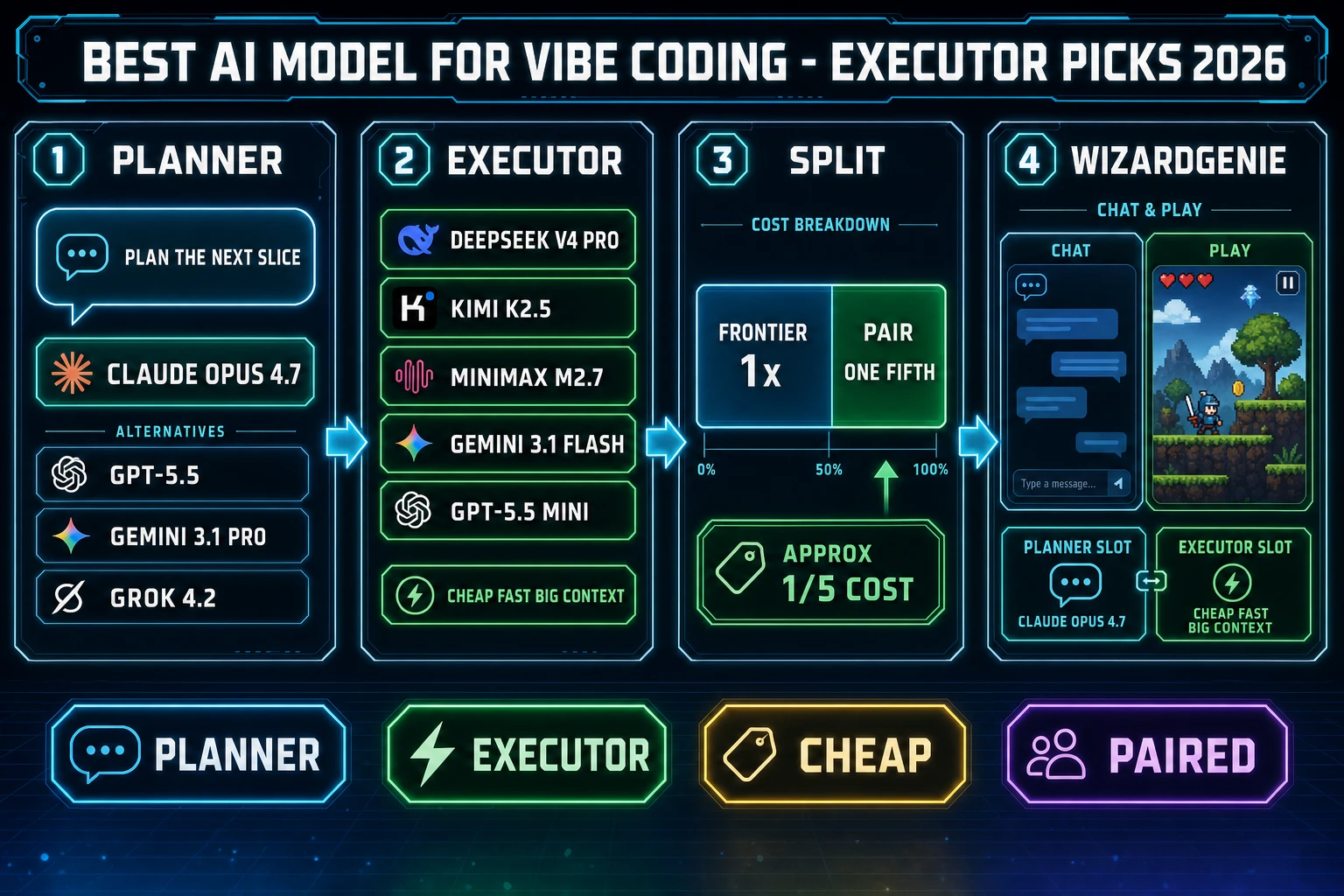
- Result: roughly one-fifth the single-frontier bill for the same shipped code. The ratio is the whole point of the pattern; give it up and you may as well run a single frontier model and skip the plumbing.
This ratio holds only if the executor is a genuinely cheap model. If the executor is Sonnet, Opus, GPT-5.5, or Gemini 3.1 Pro, the ratio collapses to roughly 4/5 - a rounding error, not a pattern. That is the entire content of Sorceress' internal "Multi-agent pairings" rule, and it is why the executor list below is narrow.
The best AI models for vibe coding as executors (five picks)
These are the five names to put on the typing seat. All five are cheap per token, fast, and carry enough context to hold a working game scene plus a few iterations without chunking. All five appear either as first-class rows in the Sorceress CODING_MODELS list or as documented light-tier siblings of frontier families.
- DeepSeek V4 Pro - the default. Sorceress tags it Budget in the coding models grid (verified 2026-09-04 in
src/app/_home-v2/_data/tools.ts). Massive-Mixture-of-Experts under the hood (see the MoE Wikipedia entry for the architecture theory) means each token only activates a fraction of the weights - which is exactly why the per-token bill stays low even as the model reasons well enough for straight typing. Set this on the executor seat first and only swap if a specific weakness shows up. - Kimi K2.5 - the long-context pick. Sorceress tags it 256K coding. Reach for K2.5 the moment your spec plus your scene plus five prior iterations exceeds ~100K tokens (a real threshold for any project past week one). K2.5 handles that without chunking; smaller-context executors will start dropping the earliest instructions.
- MiniMax M2.7 - the agent-loop pick. Sorceress tags it Agent-ready. M2.7's native tool-calling shape lets an executor run multi-step patches (edit file, run build, read log, edit again) inside a single turn without a wrapper - which matters when the loop is heavy on tool calls and you do not want the planner to arbitrate every step.
- Gemini 3.1 Flash - the light-tier frontier sibling. Not a first-class row in the Sorceress catalog (that seat goes to Gemini 3.1 Pro on the planner side), but the Flash tier is the honest executor pick when the project is already leaning on Google's stack and the developer prefers a single-vendor setup.
- GPT-5.5 Mini - the other light-tier frontier sibling. Same logic: when the planner is GPT-5.5, Mini is the natural typing partner. Do not upgrade the executor to full GPT-5.5 just because the planner is there - the whole reason the pattern exists is asymmetric price.
The five above are the executor shortlist. Kimi K2.5 and MiniMax M2.7 are the two "underrated" picks for anyone landing here from a best ai model for vibe coding reddit thread; DeepSeek V4 Pro is the default; the two light-tier siblings are the vendor-loyalty options.