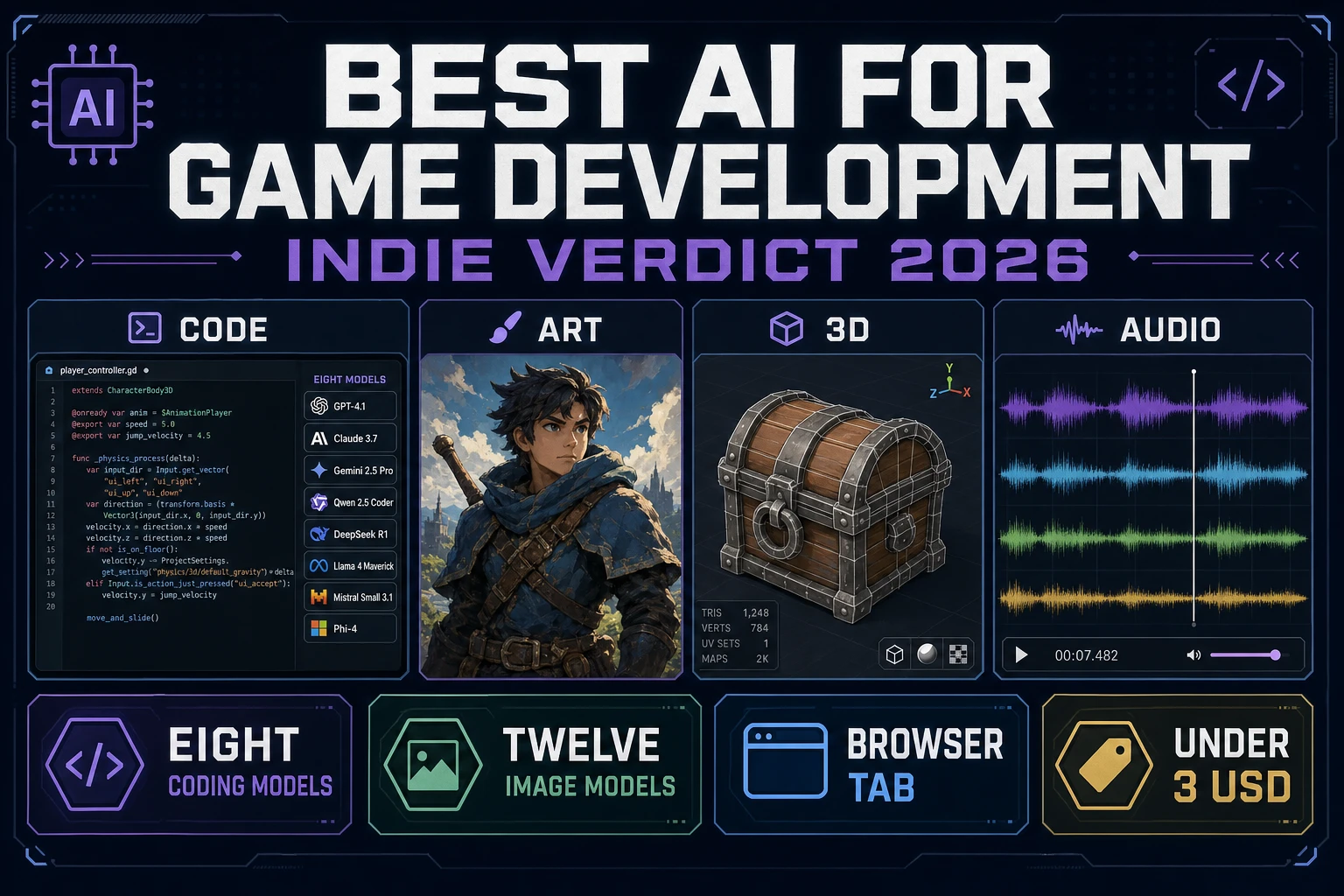
Every "best AI for game development" search in 2026 lands on the same wrong answer: pick one model. Pick Claude. Pick GPT. Pick Gemini. Pick the frontier chatbot with the highest score on someone else's leaderboard, and go make a game. That answer is what the marketing pages want, but it does not survive contact with a real Saturday-scope indie build. A single chatbot writes decent code and produces zero art, zero audio, zero rigs, and zero sprites. The honest 2026 answer is a lane-per-job stack: a coding-side model for the game logic, a text-to-image model for the concept art, a 3D model for the props, a music model for the loop, an SFX model for the cues, and a sprite model for the animated hero. This piece walks the shipping Sorceress lanes - WizardGenie, Sorceress Code, AI Image Gen, Quick Sprites, Music Gen, Auto-Rigging, and the rest of the Sorceress tools guide - and benches each one against real credit prices verified 2026-09-08 against the source tree.
What "best AI for game development" actually means in 2026
The phrase "best AI for game development" gets thrown around like it names a single product. It does not. Video game development (verified 2026-09-08 on Wikipedia) is not one job - it is roughly a dozen jobs stacked into a shipping pipeline: game design, prototyping, game code, concept art, character art, environment art, 3D models, rigging, animation, sprites, music, sound effects, voice, and publishing. Each job has a distinct set of constraints. Concept art needs a model that renders coherent scenes at 3:2 aspect. Sprite work needs a model that understands transparent backgrounds and animation frames. Music needs a model that can hit an exact loop length. Coding needs a model that understands the specific engine target - Phaser, Three.js, Godot, Unity (verified 2026-09-08 on Wikipedia). No single model is best at all of these. Asking "which AI is best for game development" is asking "which single tool is best for building a house" - the honest answer is a hammer, a saw, a drill, and a level, not one super-tool that pretends to be all four.
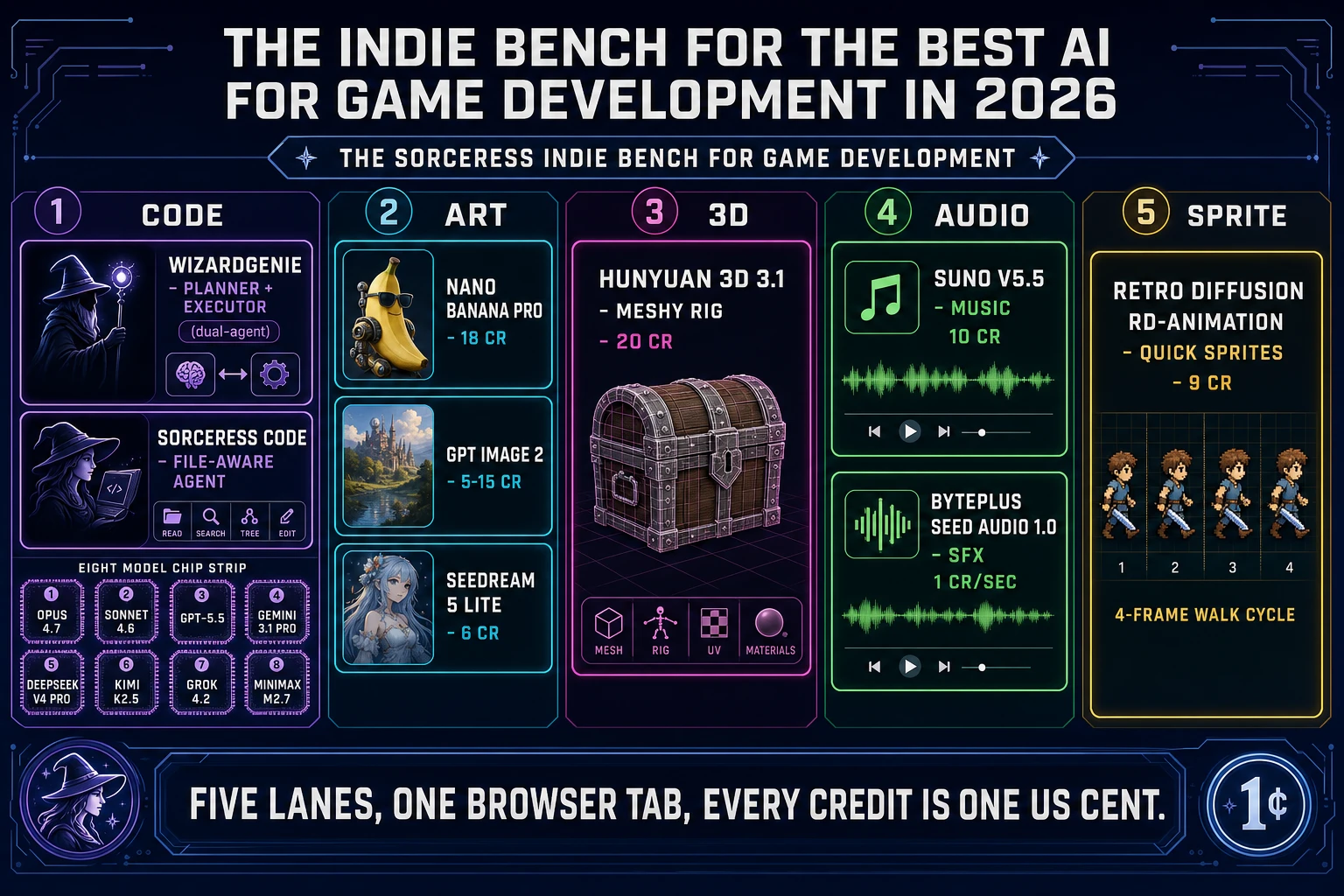
The 2026 stack breaks cleanly into six pillars: coding, art, 3D, sprites, audio, and publishing. Every asset lane bills in credits at CREDITS_PER_DOLLAR = 100 (one credit equals one US cent, verified 2026-09-08 in src/lib/models.ts line 69), so the whole pipeline stays visibly cent-priced instead of hiding behind a monthly subscription with per-generation caps. The Sorceress shipping stack maps each pillar to a dedicated surface - WizardGenie and Sorceress Code for coding, AI Image Gen for concept and character art, 3D Studio plus Auto-Rigging for props and character meshes, Quick Sprites plus Auto-Sprite v2 for the sprite lane, Music Gen plus SFX Gen plus Speech Gen for audio, and Publishing for the ship step. The rest of this piece benches each one against real 2026 credit prices, real model line-ups, and a real weekend-scope indie build.
The Sorceress indie bench for the best AI for game development in one minute
Skimming this piece? Here is the honest one-minute verdict, verified 2026-09-08 against the Sorceress source tree. Coding: eight models in Sorceress Code (Claude Opus 4.7, Claude Sonnet 4.6, GPT-5.5, Gemini 3.1 Pro, DeepSeek V4 Pro, Kimi K2.5, Grok 4.2, MiniMax M2.7), plus the WizardGenie Dual-agent Planner + Executor mode that pairs an expensive reasoner with a cheap fast typer. Art: twelve text-to-image models in AI Image Gen with per-model reference-image caps ranging from 3 to 16. 3D: Hunyuan 3D 3.1 for both mesh generation and voxel work, plus Meshy at 20 credits per rig for the auto-rig step. Sprites: Retro Diffusion RD-Animation in Quick Sprites at 9 credits per generation, plus Auto-Sprite v2 for video-to-frames work. Audio: Suno V5.5 at 10 credits per music generation, BytePlus Seed Audio 1.0 at 1 credit per SFX-second, and a full voice-cloning slot for NPC voices. Publishing: the My Games surface handles the ship step.
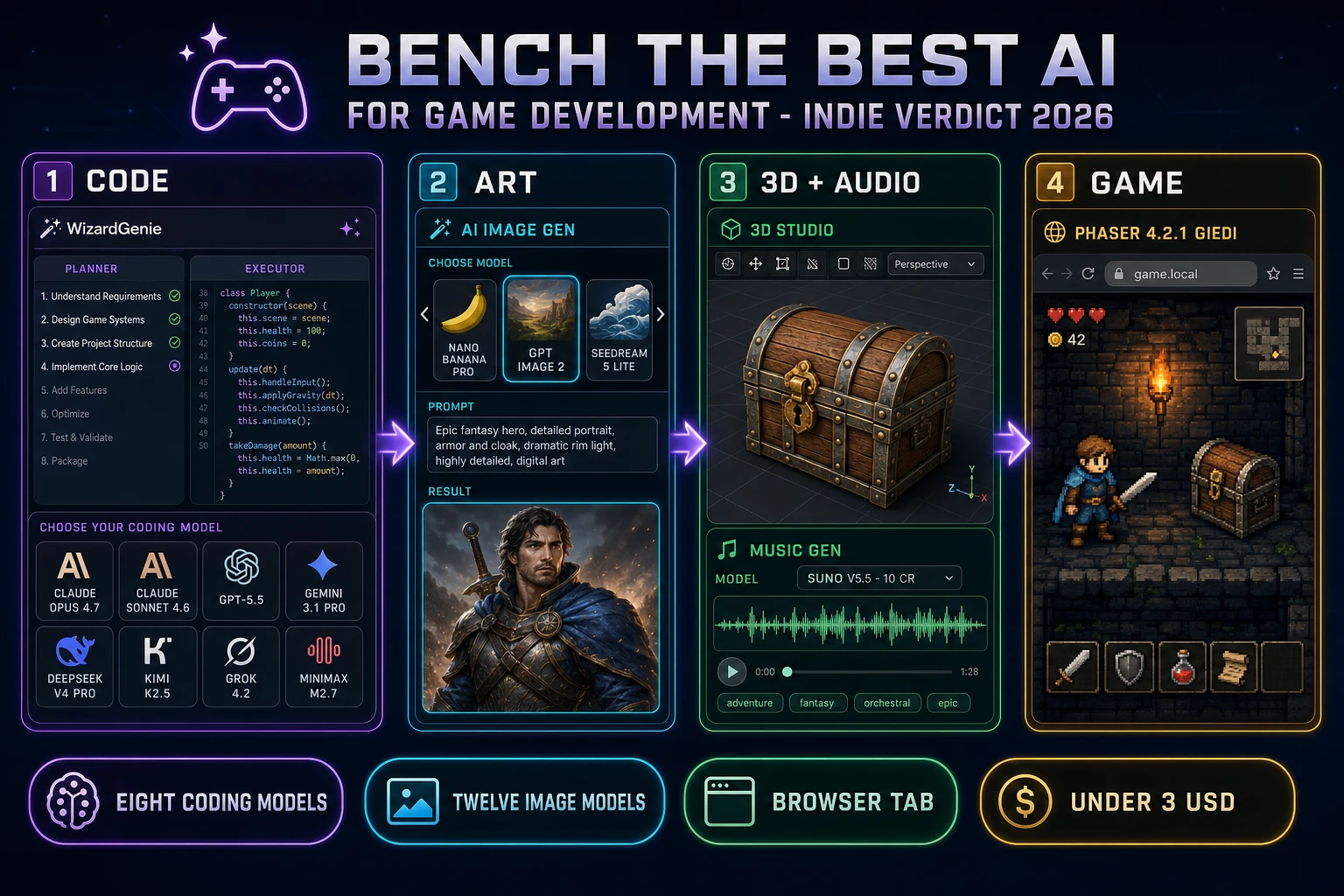
The stack composes. A concept prompt in AI Image Gen lands a hero portrait. That portrait pastes into Quick Sprites as a reference image for the animated walk cycle. The walk cycle hands off to the Sprite Analyzer for frame parsing. The sprite sheet loads into a WizardGenie Phaser scene. The scene compiles inside a browser tab, plays inside a browser tab, and ships from the browser tab. That is not a marketing composite. That is the actual asset flow, and every hand-off step is a single button in a real UI verified against the Sorceress src/app/ pages. The rest of this bench walks each lane and calls out the honest winner for the indie use case.
WizardGenie as the game-engine AI - Planner plus Executor
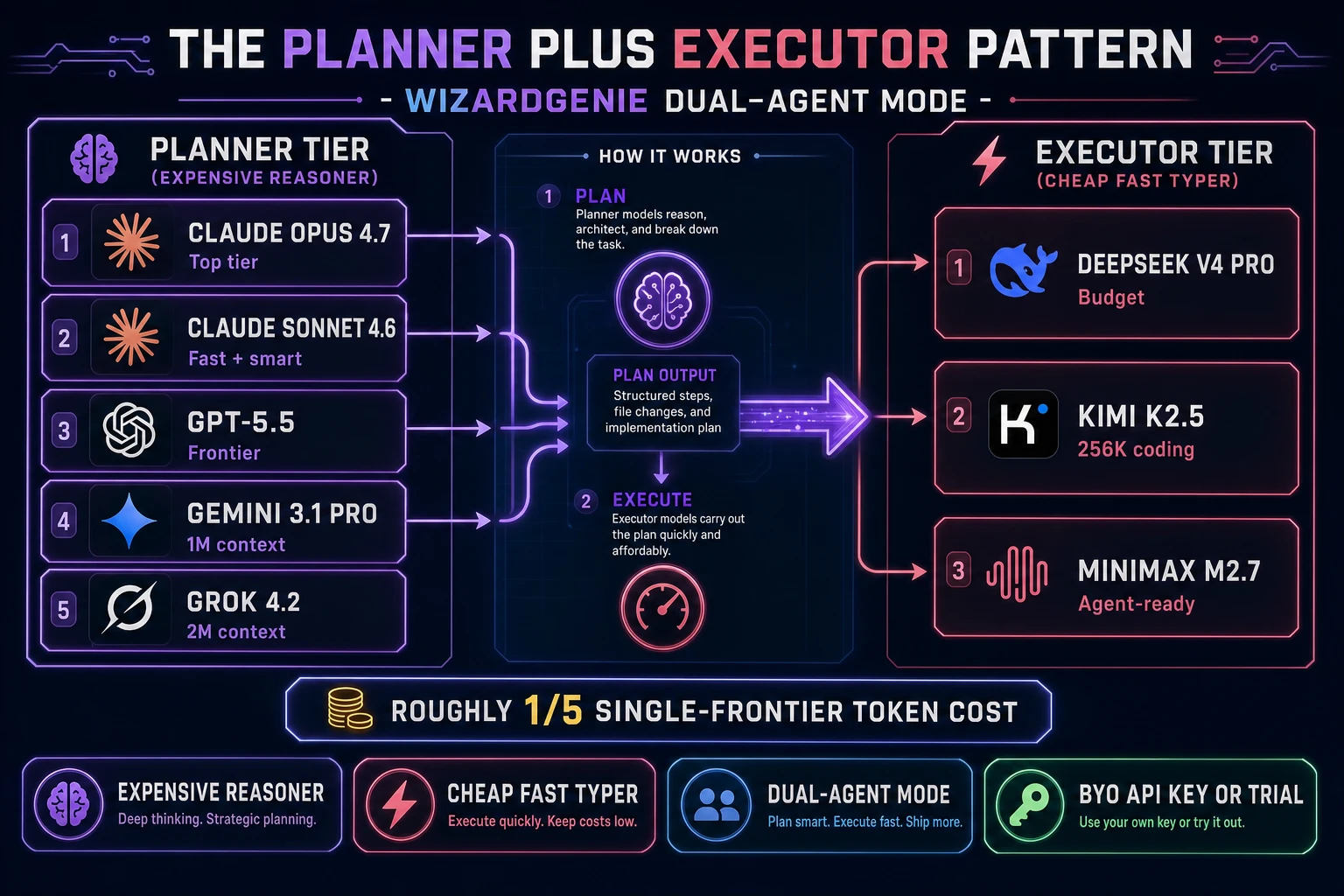
WizardGenie is the shipping AI-native game engine that ties the coding lane to the asset lanes. The header feature on the WizardGenie marketing surface (verified 2026-09-08 in src/app/wizard-genie/page.tsx line 297) is the Dual-agent Planner plus Executor mode. The pattern is honest: an expensive reasoning model plans the change, decides which files to touch, and writes the diff spec, and a cheap fast typer runs the actual edits. The economic logic is that a frontier chat that costs roughly ten times per Mtok what a good executor costs should not be spending its output tokens on repetitive typing. The AI agents for game development loop-path piece walks the Planner plus Executor architecture in detail, and the earlier 2026 browser stack rundown covers where the pattern fits in the broader Sorceress workflow.
The Planner tier in 2026 covers Claude Opus 4.7 (Top tier), Claude Sonnet 4.6 (Fast plus smart), GPT-5.5 (Frontier), Gemini 3.1 Pro (1M context), and Grok 4.2 (2M context) - the five expensive reasoners in the Sorceress Code line-up (verified 2026-09-08 in src/app/_home-v2/_data/tools.ts lines 766-775). The Executor tier covers DeepSeek V4 Pro (Budget), Kimi K2.5 (256K coding), and MiniMax M2.7 (Agent-ready) - the three genuinely cheap fast typers. Never put Sonnet-in-Sonnet-out on the executor side; that pairing erases roughly 80 percent of the cost advantage the pattern exists to deliver. WizardGenie's dual-agent surface defaults to a sane pair (an Opus or GPT-5.5 planner with a DeepSeek V4 Pro executor is the honest indie default in 2026) and lets the developer swap either tier at runtime.