Ask What Is the Best AI Model for Coding (Games 2026)

By Arron R.12 min read
What is the best AI model for coding in 2026 is not one model - it is a Planner+Executor pair. Claude Opus 4.7 plans, Sonnet 4.6 or DeepSeek V4 Pro types, Gemin

Type what is the best ai model for coding into a search bar in September 2026 and the answer changes across the top three results - Anthropic ships Claude Opus 4.7 next to Opus 4.8 and Opus 5 on the same top-tier price, OpenAI has cycled through GPT-5.5 to gpt-6-astra with the mid-tier 5.6 family in between, Google Gemini 3.1 Pro Preview holds the 1M-context planner seat, and DeepSeek V4 Pro-0813 sits at roughly one-tenth the output price of Claude. That churn is why a searcher deserves a framework, not a single-name reply. This piece walks the honest 2026 answer step by step, mapping each question the searcher is really asking to the eight models Sorceress rotates in WizardGenie and Sorceress Code. Every price, context window, and model version was verified 2026-09-10 against the vendor documentation pages and the Sorceress source in src/app/_home-v2/_data/tools.ts and src/app/code/page.tsx.
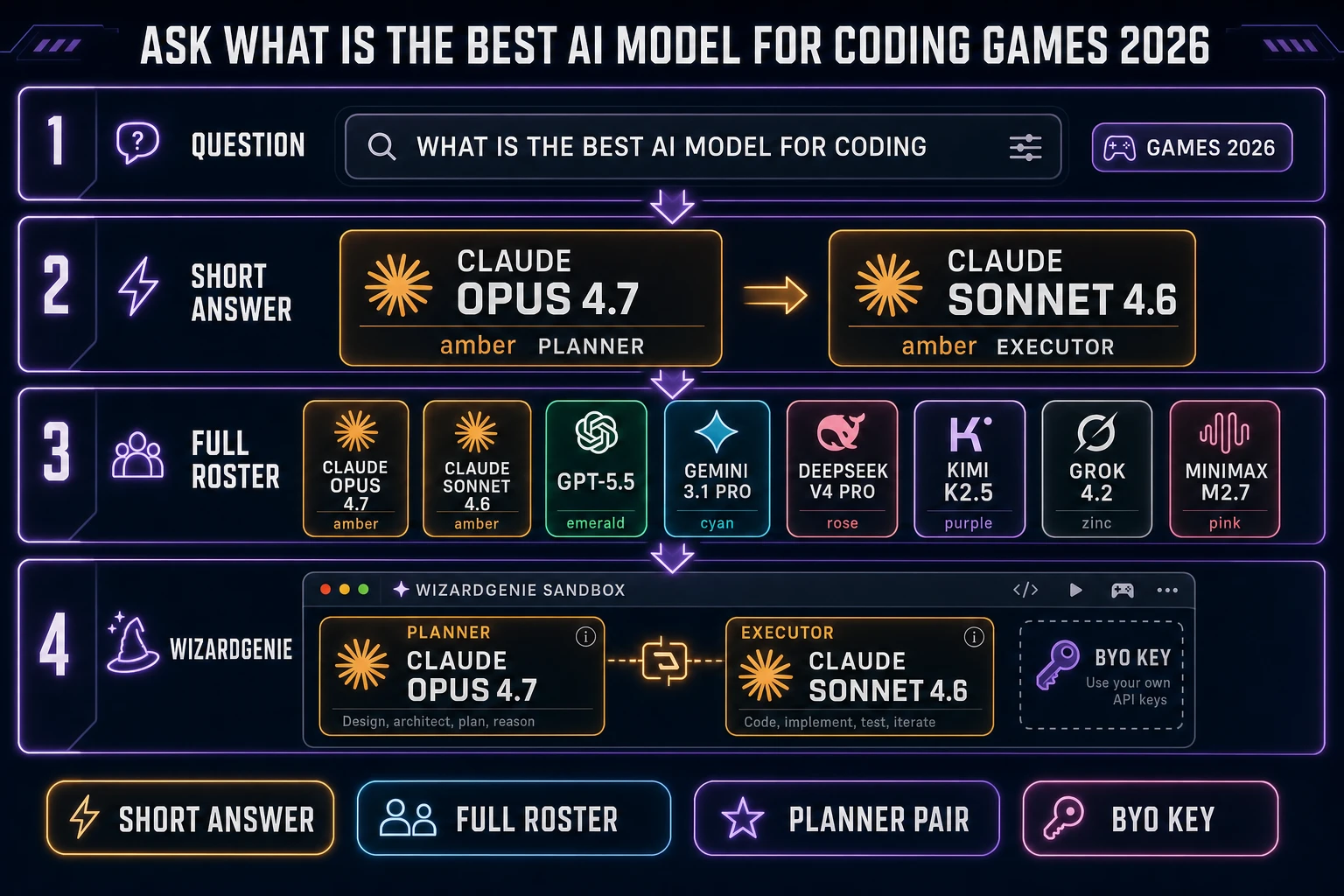
Answer chart for what is the best AI model for coding in 2026 showing Claude Opus 4.7 as planner Claude Sonnet 4.6 as executor and the full eight-seat Sorceress rotation Gemini 3.1 Pro DeepSeek V4 Pro Kimi K2.5 Grok 4.2 MiniMax M2.7 GPT-5.5
What is the best AI model for coding in 2026: a short-answer pair (Opus 4.7 + Sonnet 4.6) sitting on top of the full eight-seat Sorceress rotation, verified 2026-09-10.

The short answer to “what is the best AI model for coding” in 2026

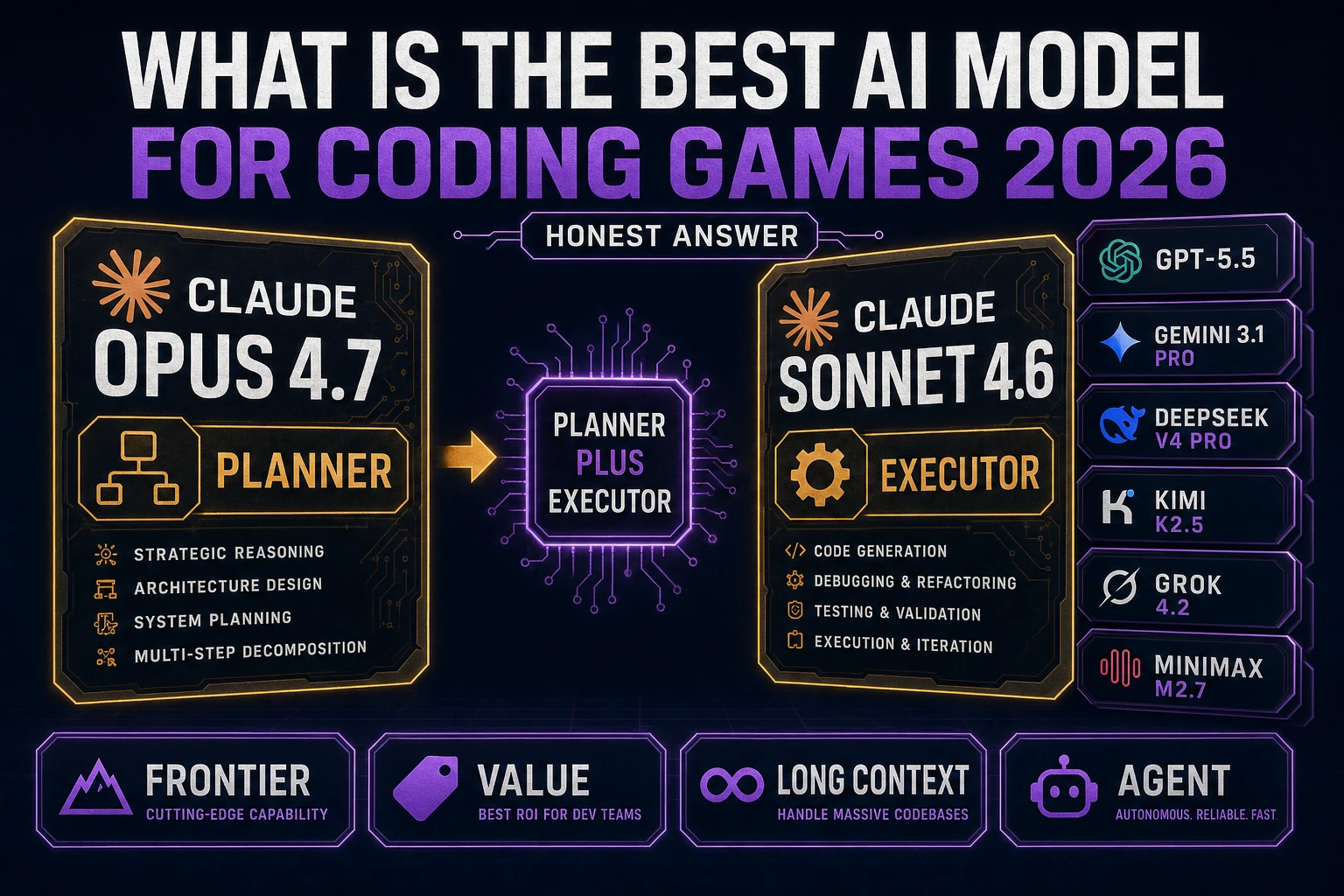
The single-line answer, verified 2026-09-10, is Claude Opus 4.7 - it is the frontier reasoner that wins the hardest cross-file coding task in one pass, and it sits on the same $5 input / $25 output per million tokens tier as newer Opus 4.8 and Opus 5 on the Anthropic pricing page. If “best” has to resolve to a single name, that is the honest 2026 pick.

The single-line answer is also the wrong answer. A working coder does not just plan - they type, paste large contexts, and script tool-use loops. The three-job answer is the one that actually holds up on Monday morning: Claude Opus 4.7 plans, Claude Sonnet 4.6 or DeepSeek V4 Pro types, MiniMax M2.7 runs the agent-shaped loops. That triple is what Sorceress ships as the WizardGenie Planner+Executor mode. The rest of this article walks the reasoning behind the pair, then charts all eight seats so anyone landing here from a different query still gets a useful map.

Why no single AI model wins “best for coding” in 2026

The question “what is the best ai model for coding” has three failure modes when it gets answered lazily. The first is naming one model and stopping - useful for a headline, useless when the market rotates its top spot every eight weeks. The second is naming a benchmark leaderboard result like HumanEval or SWE-Bench - useful for research papers, useless when the coder needs to plan a Godot state machine, then type edits across nine files, then run a browser test. The third is quoting a price without a context window - useful for a spreadsheet, useless when the paste is a whole Unity project.

Coding work in 2026 splits cleanly into three jobs, and the honest “best” answer maps one model to each job:

  • Plan. One model reasons about the whole task, drafts the design, and emits the plan. This is a frontier-reasoning seat. Volume is low - a handful of long prompts per session. Cost per output token can be high.
  • Type. A different model executes the plan by writing code into files, one edit at a time. This is the executor seat. Volume is high - dozens of short prompts. Cost per output token has to be low.
  • Loop. A third model runs open-file, patch, save, retest, report cycles as tool-use JSON. Volume varies. Reliability on the multi-step chain matters more than raw reasoning quality.

No single model in 2026 wins all three jobs at the price the pair wins them. Opus 4.7 at $5 / $25 per MTok is roughly five times the per-output-token cost of Sonnet 4.6 at $3 / $15, and Sonnet 4.6 is roughly ten times the cost of DeepSeek V4 Pro on typing tasks. Using Opus for typing burns money the pair does not need to burn. Using DeepSeek for frontier reasoning on a hard cross-file design lands the code slower, or wrong, and the retry cost eats the savings. That is why an honest 2026 answer maps three seats, not one.

The eight AI coding models Sorceress rotates in 2026

Verified 2026-09-10 in src/app/_home-v2/_data/tools.ts lines 766 to 775, the Sorceress CODING_MODELS constant is exactly eight entries. Each seat has a role, an accent color in the model picker, and a job the other seven do not cover.

Model Provider Tag Job in the rotation
Claude Opus 4.7AnthropicTop tier (amber)Default planner; frontier reasoning, tokenizer parity with Sonnet 4.6
Claude Sonnet 4.6AnthropicFast + smart (amber)Tokenizer-matched executor; one-fifth the output price of Opus 4.7
GPT-5.5OpenAIFrontier (emerald)Alternate planner; last stable step before the GPT-5.6 family
Gemini 3.1 ProGoogle1M context (cyan)Whole-project planner; 1M input window fits a full Godot repo
DeepSeek V4 ProDeepSeekBudget (rose)Cheapest executor; free web chat on chat.deepseek.com
Kimi K2.5Moonshot256K coding (purple)Free-tier alternate planner; unlimited on kimi.com
Grok 4.2xAI2M context (zinc)Backup planner; 2M window is the emergency paste seat
MiniMax M2.7MiniMaxAgent-ready (pink)Agent executor; open-edit-save loop without dropping a step

The tag column is not marketing - it is the seat’s job. “Top tier” and “Fast + smart” describe the Anthropic planner+executor pair. “Frontier” is a single premium seat for shops with an OpenAI key. “1M context” and “2M context” describe the two seats that exist because a whole game project pasted at once exceeds any 200k-window model. “Budget” and “256K coding” describe the two lanes that keep the per-token cost low. “Agent-ready” describes the seat that types a five-step tool-use loop reliably. Any “best AI model for coding” pick that names one seat is skipping seven of the eight jobs.
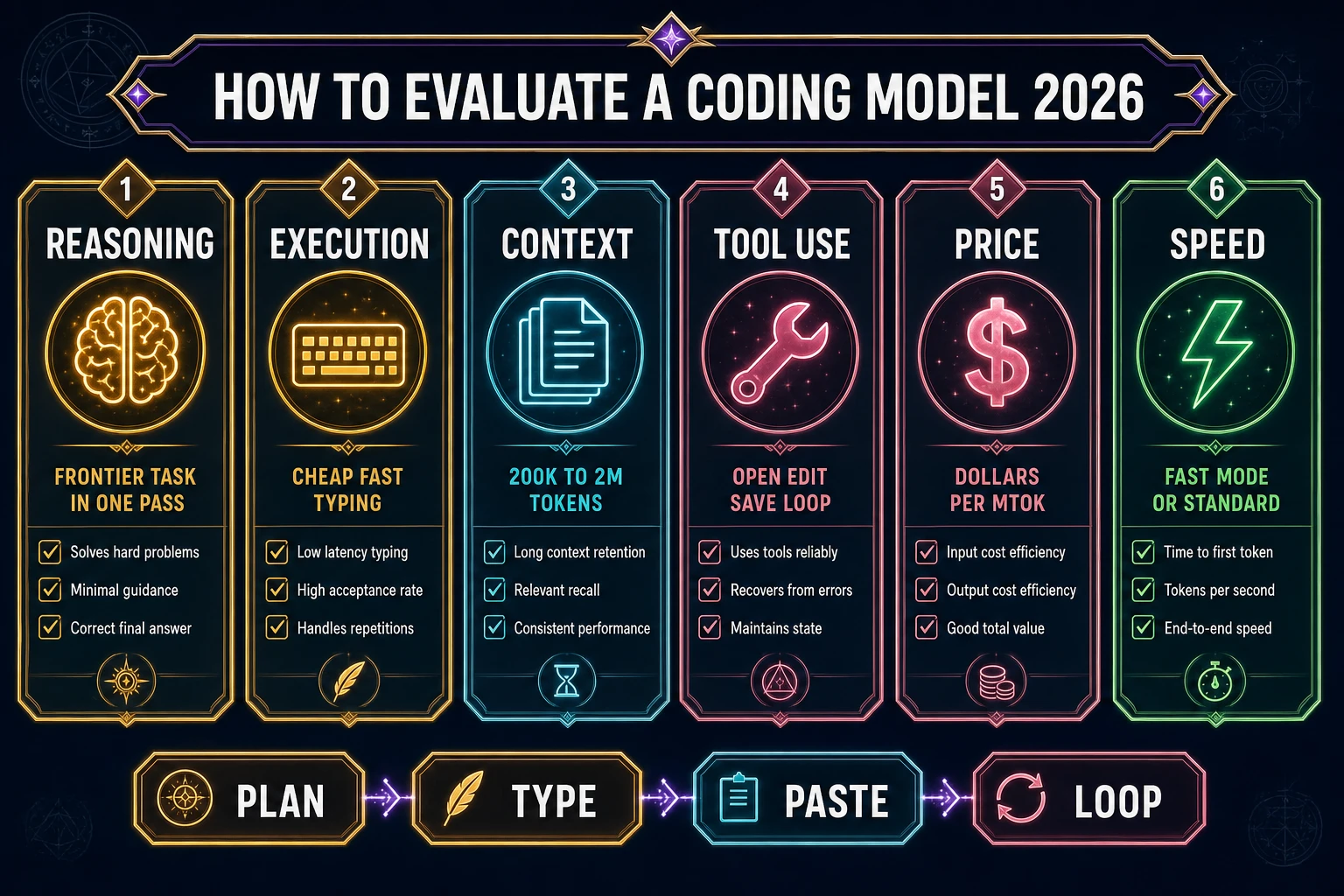
How to evaluate a coding model 2026 checklist showing reasoning execution context tool use price speed cards each with a Sorceress accent color amber cyan pink rose emerald
The honest 2026 checklist for what is the best AI model for coding - six criteria, each mapped to a Sorceress seat.

How to evaluate an AI coding model in 2026 - the honest checklist

Before naming a “best”, name the criteria. The 2026 checklist that Sorceress scores the eight models against has six lines. Every model in the rotation was measured against every line before the seat was assigned.

  1. Frontier reasoning. Can the model draft a Phaser 4.2.1 scene lifecycle with correct pointer events on the first try? Can it refactor a Godot signal graph across nine scripts without losing a connection? On 2026-09-10 the answer is Opus 4.7 or Gemini 3.1 Pro for the frontier tier, with GPT-5.5 as the alternate.
  2. Execution speed and price. How many typing turns per dollar? Sonnet 4.6 at $3 / $15 per MTok is the tokenizer-matched pair with Opus 4.7. DeepSeek V4 Pro Non-Think mode is roughly one-tenth of that on output. Kimi K2.5 free tier is $0.
  3. Context window. How much of the project fits in one prompt? Gemini 3.1 Pro at 1M is the 2026 default for whole-project planning. Grok 4.2 at 2M is the emergency window. Kimi K2.5 at 256K fits four to five files. Everything else below 200k truncates a real game repo.
  4. Tool use rate. How reliably does the model emit valid tool-use JSON across a five-step chain? MiniMax M2.7 was scored for exactly this. Frontier reasoners often lose the plot at step four.
  5. Tokenizer parity for handoffs. Verified 2026-09-10 on Anthropic pricing: Claude 4.7 and later use a newer tokenizer that produces roughly 30% more tokens for the same text. That is why Opus 4.7 pairs cleanly with Sonnet 4.6, and why Opus 4.7 + Sonnet 4.5 or older would not.
  6. Fast mode where it exists. Fast mode on Anthropic is available only on Claude Opus 5 and Opus 4.8 at $10 input / $50 output per MTok. Verified 2026-09-10: Fast mode is not available on Claude Opus 4.7. That is a reason a shop optimizing for latency might reach past 4.7 to 4.8.

Any “best AI model for coding” answer that skips the last three criteria is answering a different question. Context window, tool-use rate, and tokenizer parity are where a real workflow lives or dies, and none of them show up on a leaderboard.
Frontier vs value vs budget - three price tiers, three real answers

The 2026 pricing pages have widened enough that “best AI model for coding” splits into three answers depending on which tier the shop lives on. The three tiers below were verified 2026-09-10 on the vendor pages, and each maps to a Sorceress seat.

Tier Best AI coding model Input / Output per MTok Why this pick
FrontierClaude Opus 4.7$5 / $25Same tier as newer Opus 4.8 and Opus 5; tokenizer pair with Sonnet 4.6
Frontier altGemini 3.1 Pro Preview$2 / $12 (≤200k) or $4 / $18 (>200k)1M-token input window for whole-project pastes
Frontier altGPT-5.5Frontier tier (OpenAI)Last stable step before the GPT-5.6 family cadence
ValueClaude Sonnet 4.6$3 / $15Tokenizer-matched pair with Opus 4.7; fast smart executor
Value altClaude Sonnet 5$2 / $10Newer, cheaper Sonnet on the same Anthropic tokenizer family
BudgetDeepSeek V4 Pro<$0.30 / <$1.20 (roughly)Non-Think mode types at roughly one-tenth Sonnet 4.6 cost
Free tierKimi K2.5$0 on kimi.comUnlimited Instant and Thinking modes; 256K context
Free tierDeepSeek web chat$0 on chat.deepseek.comV4 Pro reasoning available in browser without an API key

What that chart says is straightforward: the frontier tier is Anthropic Opus, Google Gemini Pro, or OpenAI GPT-5.5 depending on which vendor a team already pays. The value tier is Sonnet (4.6 for tokenizer parity, 5 for the newer cheap seat). The budget tier is DeepSeek. The free tier is Kimi and DeepSeek web chat. Reach for the tier that matches the wallet, then reach for the pair inside that tier.

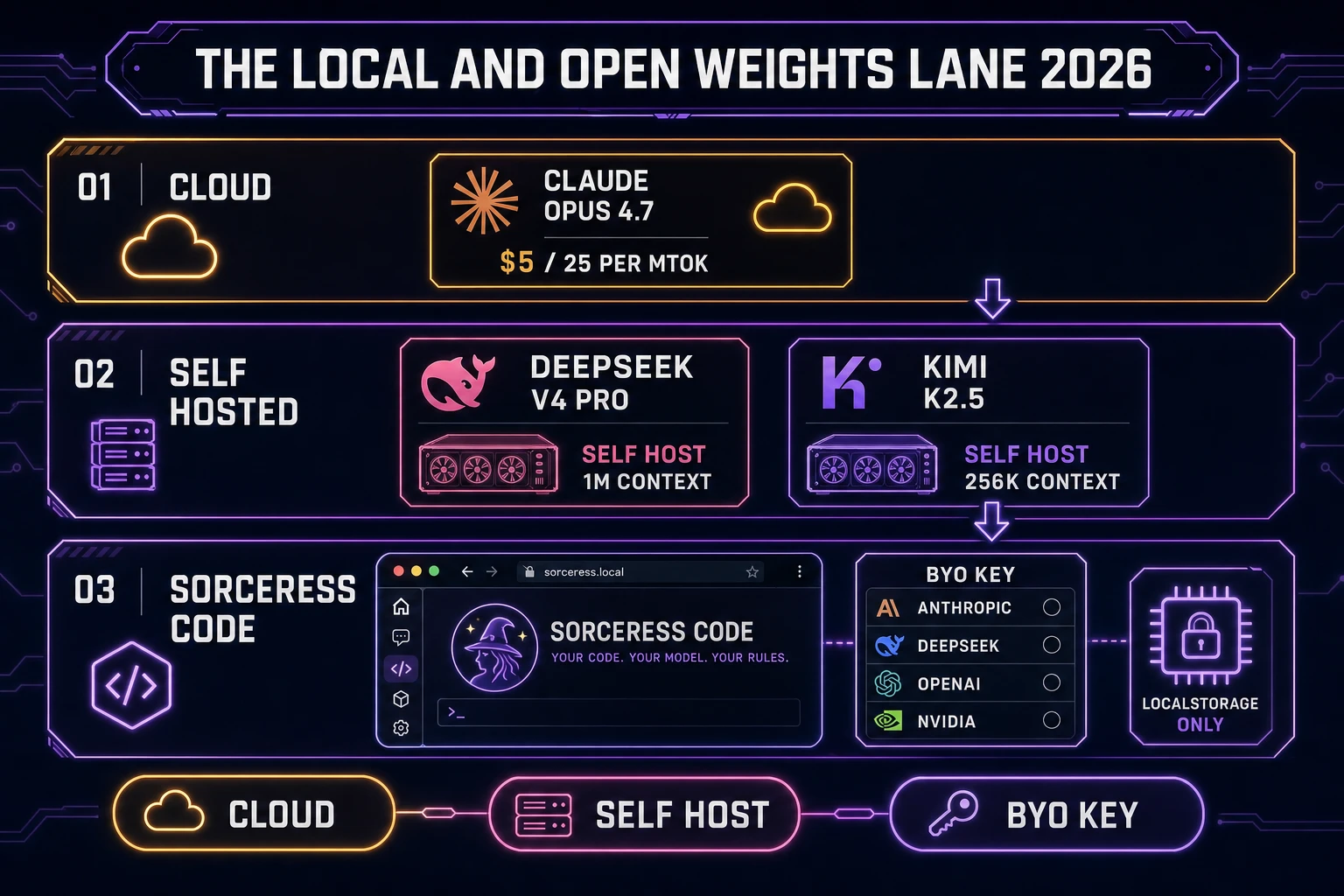
Local and open weights lane diagram showing cloud Claude Opus 4.7 self-hosted DeepSeek V4 Pro and Kimi K2.5 and Sorceress Code BYO key panel with anthropic deepseek openai nvidia providers stored in localStorage only
The local and open-weights lane for what is the best AI model for coding in 2026 - DeepSeek V4 Pro and Kimi K2.5 self-hosted, wired into Sorceress Code through the BYO-key panel.

Local and open-weights - what the offline lane offers in 2026

If the honest question is “what is the best AI model for coding I can run locally in 2026”, the answer is not on the Anthropic pricing page. Two of the eight Sorceress seats ship open-weights checkpoints that a workstation can run: DeepSeek V4 Pro (verified 2026-09-10 in the DeepSeek release notes) and Kimi K2.5 (verified 2026-09-10 on the Moonshot platform docs). Both fit on a single high-end GPU or a two-GPU workstation, both hold their own on Phaser and Godot code, both cost $0 per token after the hardware is paid.

Local wins on three axes: privacy (nothing leaves the machine, useful for NDA client work), offline reliability (a train ride or a jam-site with bad Wi-Fi still ships code), and marginal cost ($0 per output token beats every cloud price by definition). Local loses on three axes: peak reasoning quality (Opus 4.7 still wins on the hardest cross-file refactor), context window (running 1M context on a 24 GB card is not practical yet in 2026), and time to first token (a hosted API is usually faster than a cold local inference server).

Sorceress itself does not run local inference. What it does ship, verified 2026-09-10 in src/app/code/page.tsx lines 1178 and 1846 to 1855, is BYO-key slots for four providers - anthropic, deepseek, openai, and nvidia - and a separate sorcgcs_server_url localStorage slot for a filesystem bridge. Any OpenAI-compatible endpoint URL plugs into that slot, which is how a local Ollama or vLLM server takes over the executor lane while the frontier planner still calls the hosted Opus 4.7 API. Keys live only in browser localStorage - the on-page banner reads “API keys are stored locally in your browser and sent directly to the AI providers. They are never stored on our servers.”

The Sorceress Code rotation and BYO-key setup on 2026-09-10

The final answer to “what is the best AI model for coding” only lands when the model is actually reachable from where the code is being written. Sorceress ships two surfaces for that.

WizardGenie is the dual-agent surface. It renders a Planner slot and an Executor slot side by side, so a workflow that pairs Opus 4.7 with Sonnet 4.6 (or Opus 4.7 with DeepSeek V4 Pro) is a single UI choice, not a multi-tool orchestration project. WizardGenie ships on both desktop (Windows installer with auto-updater) and web (no-install browser tab). Desktop unlocks native filesystem access and longer agent sessions; web is the zero-install option for a game-jam weekend.

Sorceress Code is the direct BYO-key coding surface. Verified 2026-09-10 in src/app/code/page.tsx, the Provider type is 'anthropic' | 'deepseek' | 'openai' | 'nvidia', and the localStorage keys are sorcgcs_api_key_anthropic, sorcgcs_api_key_deepseek, sorcgcs_api_key_openai, and sorcgcs_api_key_nvidia. A single NVIDIA NIM key unlocks Kimi K2.5 and multiple catalog models with free credits on signup. Setup is roughly:

  1. Open Sorceress Code, click Settings, paste the vendor key into the matching slot. Nothing hits Sorceress servers.
  2. Pick the planner seat in the model dropdown (Opus 4.7 default, Gemini 3.1 Pro for whole-project pastes, GPT-5.5 for OpenAI shops).
  3. Pick the executor seat (Sonnet 4.6 for the tokenizer pair, DeepSeek V4 Pro for the budget path).
  4. Route the agent-shaped loops to MiniMax M2.7 through the same Provider dropdown.

Verified 2026-09-10 in src/lib/models.ts line 69: CREDITS_PER_DOLLAR = 100, so one Sorceress credit equals one US cent of underlying provider spend. Verified 2026-09-10 in src/app/plans/page.tsx line 51: LIFETIME_PRICE = 49, so the Lifetime Early Access tier is $49 one-time - it unlocks the desktop WizardGenie build with auto-updater; per-token spend on the underlying models is still pass-through at $0.01 per credit.

The verdict - what to actually reach for on Monday morning

The full 2026 answer to “what is the best AI model for coding” is not one name and not eight names - it is a small ranked list keyed to the job in front of the coder.

  • Hard cross-file refactor across three to nine files. Claude Opus 4.7 (planner) → Claude Sonnet 4.6 (executor). Same tokenizer, one-fifth the output cost on the typing side. This is the default 2026 pick.
  • Whole-project paste, everything in one prompt. Gemini 3.1 Pro (planner) → DeepSeek V4 Pro Non-Think (executor). 1M input window fits a full Godot repo; DeepSeek types the edits at roughly one-tenth Sonnet 4.6 cost.
  • Emergency 2M-token paste (the entire example gallery plus the design doc plus the game code). Grok 4.2 (planner) → DeepSeek V4 Pro (executor). Grok 2M is the only seat in the rotation that swallows the paste.
  • Agent loops (open, patch, save, retest, report). Anything on the planner side → MiniMax M2.7 (agent executor). This is what turns a plan into a script.
  • Game-jam weekend with no credit card. Kimi K2.5 free on kimi.com (planner) → DeepSeek V4 Pro free on chat.deepseek.com (executor). Two zero-dollar seats, still ships production code.
  • Latency-critical typing where fast mode helps. Claude Opus 5 or Opus 4.8 with Fast mode at $10 / $50 per MTok (verified 2026-09-10 as the only two Anthropic models where speed: "fast" is available).

The honest short answer to the query stays the same: Claude Opus 4.7. The honest working answer is the pair above. The honest tool that renders both is WizardGenie plus Sorceress Code on the Sorceress stack. Every fact in this piece was verified 2026-09-10 against the Anthropic, Google, and xAI pricing pages, and against the Sorceress CODING_MODELS source in src/app/_home-v2/_data/tools.ts. See also the sibling pieces Chart Best AI Model for Coding, Sort Best Coding AI Model, Cast Which AI Model Is Best for Coding, and Lock Best Local AI Model for Coding for deeper cuts on each lane.

Frequently Asked Questions

What is the best AI model for coding right now?

As of 2026-09-10, the honest single-pick answer is Claude Opus 4.7 for frontier reasoning. Anthropic pricing (verified 2026-09-10) lists Opus 4.7 next to Opus 4.8 and Opus 5 on the same $5 input / $25 output per million tokens tier, and 4.7 shares its tokenizer with Sonnet 4.6 which is the executor pair Sorceress rotates. For a real workflow, the answer is a pair: Opus 4.7 plans, Sonnet 4.6 or DeepSeek V4 Pro types, MiniMax M2.7 handles the agent-shaped loops. That pairing is what the Sorceress WizardGenie Planner+Executor mode ships.

Which AI coding models does Sorceress rotate in 2026?

Verified 2026-09-10 in src/app/_home-v2/_data/tools.ts lines 766 to 775, the Sorceress CODING_MODELS constant holds exactly eight seats: Claude Opus 4.7 (Top tier amber), Claude Sonnet 4.6 (Fast + smart amber), GPT-5.5 (Frontier emerald), Gemini 3.1 Pro (1M context cyan), DeepSeek V4 Pro (Budget rose), Kimi K2.5 (256K coding purple), Grok 4.2 (2M context zinc), and MiniMax M2.7 (Agent-ready pink). Each seat maps to a distinct job - frontier reasoning, fast executor, budget executor, long-context planner, huge-context backup, agent tool-use. Sorceress does not run a single-model chat - it rotates the whole grid.

What is the best AI model for coding on a budget in 2026?

DeepSeek V4 Pro. Verified 2026-09-10 in the DeepSeek API docs, the current alias resolves to DeepSeek-V4-Pro-0813 with a native 1M-token context window and three modes - Non-Think, Think High, Think Max. Non-Think mode types production code at roughly one-tenth the output cost of Claude Sonnet 4.6, and chat.deepseek.com free web chat is still open on 2026-09-10 for the wallet-empty lane. Kimi K2.5 on kimi.com Instant or Thinking mode is the other free-tier answer worth naming - 256K context, unlimited free-tier usage, purple seat in the Sorceress rotation.

Is the best AI model for coding the newest one?

Not always. Verified 2026-09-10 on the Anthropic pricing page, Claude Opus 5 / 4.8 / 4.7 / 4.6 / 4.5 all sit at the same $5 input / $25 output per MTok top tier. The reason Sorceress holds on Opus 4.7 rather than newer Opus 4.8 or Opus 5 is not price - it is tokenizer parity with Sonnet 4.6, which is the executor pair. Claude 4.7 and later use a new tokenizer that produces roughly 30% more tokens per unit of text, so the pair of Opus 4.7 + Sonnet 4.6 gives clean handoffs. Newer is not always better; matched is.

Which AI model has the biggest context window for coding in 2026?

Grok 4.2 at 2M tokens. Verified 2026-09-10 in docs.x.ai/docs/models, xAI publishes grok-4.20-0309-reasoning with a 1M context window at $1.25 short / $2.50 long output per MTok, and legacy Grok 4.2 with the full 2M window as the emergency long-context seat. Gemini 3.1 Pro at 1M is the 2026 default for whole-project planning; Grok is the seat when even 1M is not enough. DeepSeek V4 Pro also lists a 1M native context on the current release. Kimi K2.5 sits at 256K, which fits four to five files per prompt.

Sources

  1. Anthropic Pricing - Claude Opus 4.7 and Sonnet 4.6
  2. Google Gemini API Pricing - Gemini 3.1 Pro Preview
  3. xAI Models Documentation - Grok 4.20 Reasoning and Grok 4.6
  4. Phaser Framework Release Notes
  5. Large Language Model - Wikipedia
  6. Games - MDN Web Docs
Written by Arron R.·2,621 words·12 min read

Related posts