AI Sound Effects Generator (Browser SFX Pack 2026)

By Arron R.12 min read
AI sound effects generator in late 2026 means a text-to-audio model that returns discrete game-ready clips. Sorceress SFX Gen wraps BytePlus Seed Audio 1.0 (1 c

An AI sound effects generator in 2026 is a text-to-audio neural network: type metal door slam, close mic, short reverb tail, wait a few seconds, download an mp3 that drops straight on a jump input. The category used to be a side feature on music tools; this year it is its own shelf, and the honest game-dev question is no longer can it work but which model, at what credit cost, and how do I cue the clip in a browser without the first jump going silent. This ranking covers the two live models in Sorceress SFX Gen, how they stack against the broader AI SFX landscape, and the trim + preload path that keeps the pack playable. Every number is pulled live from source on 2026-10-02.
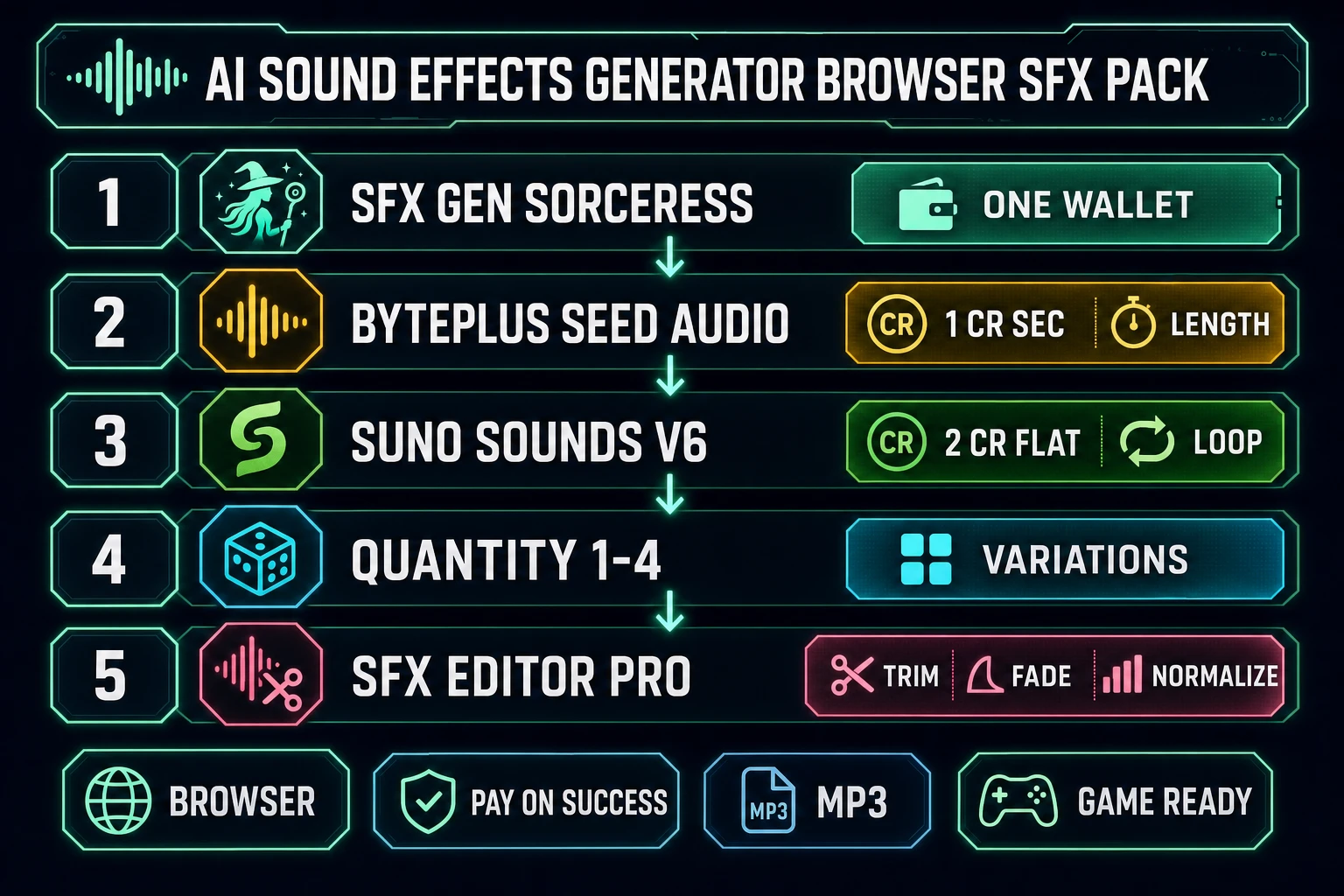
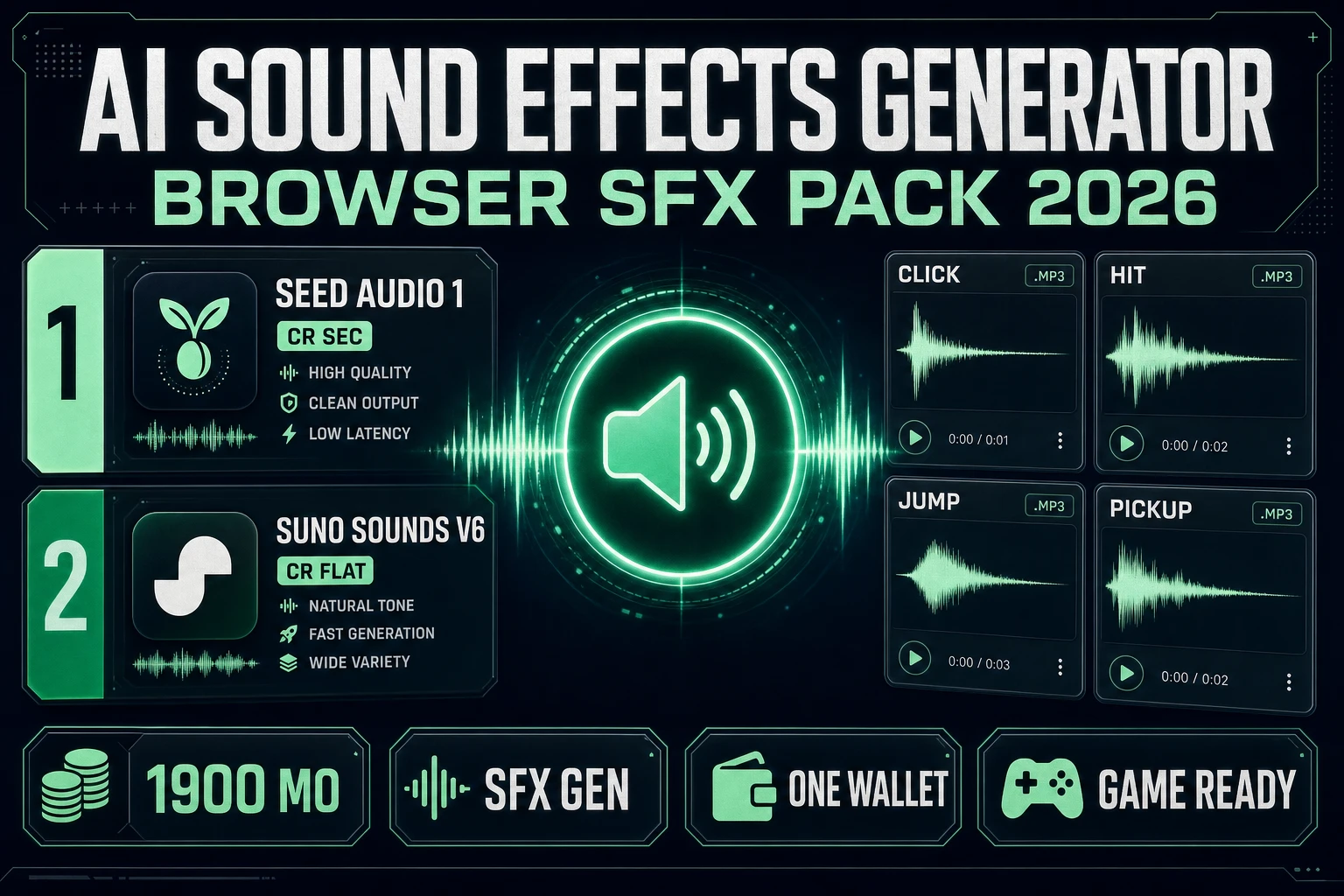
AI sound effects generator ranking: Sorceress SFX Gen, BytePlus Seed Audio 1 credit per second, Suno Sounds V6 flat 2 credits, Quantity 1 to 4, SFX Editor trim and fade
AI sound effects generator stack for 2026: two provider models under one wallet, trim in SFX Editor, cue through HTMLAudioElement.

What people searching “ai sound effects generator” actually want

DataForSEO lists ai sound effects generator at 1,900 searches a month, KD 29, competition 0.34, intent transactional (verified 2026-10-02 in tools/research-supplement.md). The sibling query ai sound effects generator free sits at 260/mo, KD 28, and the variants sound effects ai generator and sound effects generator ai add another ~220 combined. That cluster totals more than 2,300 monthly searches, nearly all of them shopping intent — the user already knows the category exists and is picking between tools.

The query is not a request for a Foley tutorial. Wikipedia’s Foley (sound design) entry (verified 2026-10-02) is clear that Foley is “the reproduction of everyday sound effects that are added to films, videos, and other media in post-production” — a human artist performing in sync with the picture. An AI sound effects generator cannot do that performance; it ships prompt-conditioned one-shots instead. The two tools are complements, not substitutes. Searchers who type the AI phrase have already decided they want the one-shot path.

What they are weighing between tools:

  • Can I ask for a specific length (0.3 s UI click, 2 s jump whoosh, 15 s ambient bed)?
  • Will the clip loop without a seam?
  • Is pricing per clip or per month?
  • Will the file format load in Phaser, Godot, Unity, or three.js?

Every one of those criteria is answerable without a trial subscription. The ranking below answers them in source-verified numbers.

The 2026 landscape of AI sound effects generation

Three families of model show up in the SERP for this query in 2026:

  1. Dedicated text-to-SFX models. Trained end-to-end on short discrete sound clips with text captions. Native strengths: tight transients, controllable length, prompt-conditioned timbre. BytePlus Seed Audio 1.0 and Suno Sounds V6 sit here. Competitor products in this family include ElevenLabs SFX, Stability AI’s Stable Audio Open, and Meta’s AudioCraft lineage (named here as prior art — no outbound links per house policy; the comparison lives inside the Sorceress picker).
  2. General text-to-audio music models stretched to SFX. Trained on music datasets and prompted for one-shots. They can produce usable ambience and designed stingers, but the attack on a one-second UI click is softer than category 1. Suno’s main music model, Udio, and Google’s Lyria/MusicFX line fit here.
  3. Browser aggregator stacks. One tab, one wallet, multiple provider models in a picker. Sorceress SFX Gen is the aggregator pattern applied to AI SFX. Pick the provider per clip; pay per success; keep the files locally.

For a game-dev pipeline, the dedicated SFX category wins for the hit pack (clicks, impacts, pickups), and either category 2 or a Suno Sounds V6 flat-rate call wins for loops and ambience. An aggregator buys access to both without separate subscriptions. That is the honest answer to the ranking question: a stand-alone dedicated-SFX subscription is one of three valid picks, not the only one.

Sorceress SFX Gen: BytePlus Seed Audio 1.0 and Suno Sounds V6 under one wallet

SFX Gen is the Sorceress Audio Studio tool that answers the AI sound effects generator query on this site. It ships two live models in the picker (verified 2026-10-02 in src/app/sfx-gen/page.tsx):

Model Provider Credits Length control Loop toggle
Seed Audio 1.0 (default) BytePlus 1 credit per second of finished audio, minimum 1 Target duration 1–120 s No
Suno Sounds V6 Suno via Kie Flat 2 credits per sound Not metered (flat) Yes — seamless looping

The constants are literal source values: SEED_AUDIO_CREDITS_PER_SECOND = 1, SEED_AUDIO_MIN_CREDITS = 1, SEED_AUDIO_MAX_SECONDS = 120, and SUNO_SOUNDS_CREDIT_COST = 2 (all verified 2026-10-02 in src/app/sfx-gen/page.tsx around line 23 through line 28). The default model is byteplus-seed-audio. A legacy Suno Sounds V5.5 is still callable for backward compatibility; the picker surfaces V6.

Shared tool mechanics:

  • Quantity 1 through 4. Estimated credits multiply by the Quantity count (verified 2026-10-02 in src/app/sfx-gen/page.tsx at the Quantity control around line 1891).
  • Billed on success only. A failed generation does not consume the wallet.
  • One wallet, two providers. No separate BytePlus or Suno accounts; the Sorceress top-up ledger funds both.
  • mp3 download. The generated clip plays in-browser and downloads as an mp3 you can drop into /audio/sfx/ in a game repo.

Price math is boring on purpose. CREDITS_PER_DOLLAR = 100 in src/lib/models.ts line 69 (verified 2026-10-02) means one credit is one US cent on the top-up ledger. A two-second UI click on Seed Audio costs two cents. A ten-second ambient loop on Suno Sounds V6 costs two cents flat. The 100-credit SIGNUP_GRANT at src/app/api/admin/credits/route.ts line 12 (verified 2026-10-02) covers 100 short Seed Audio one-shots or 50 Suno Sounds calls before the wallet needs a refill.
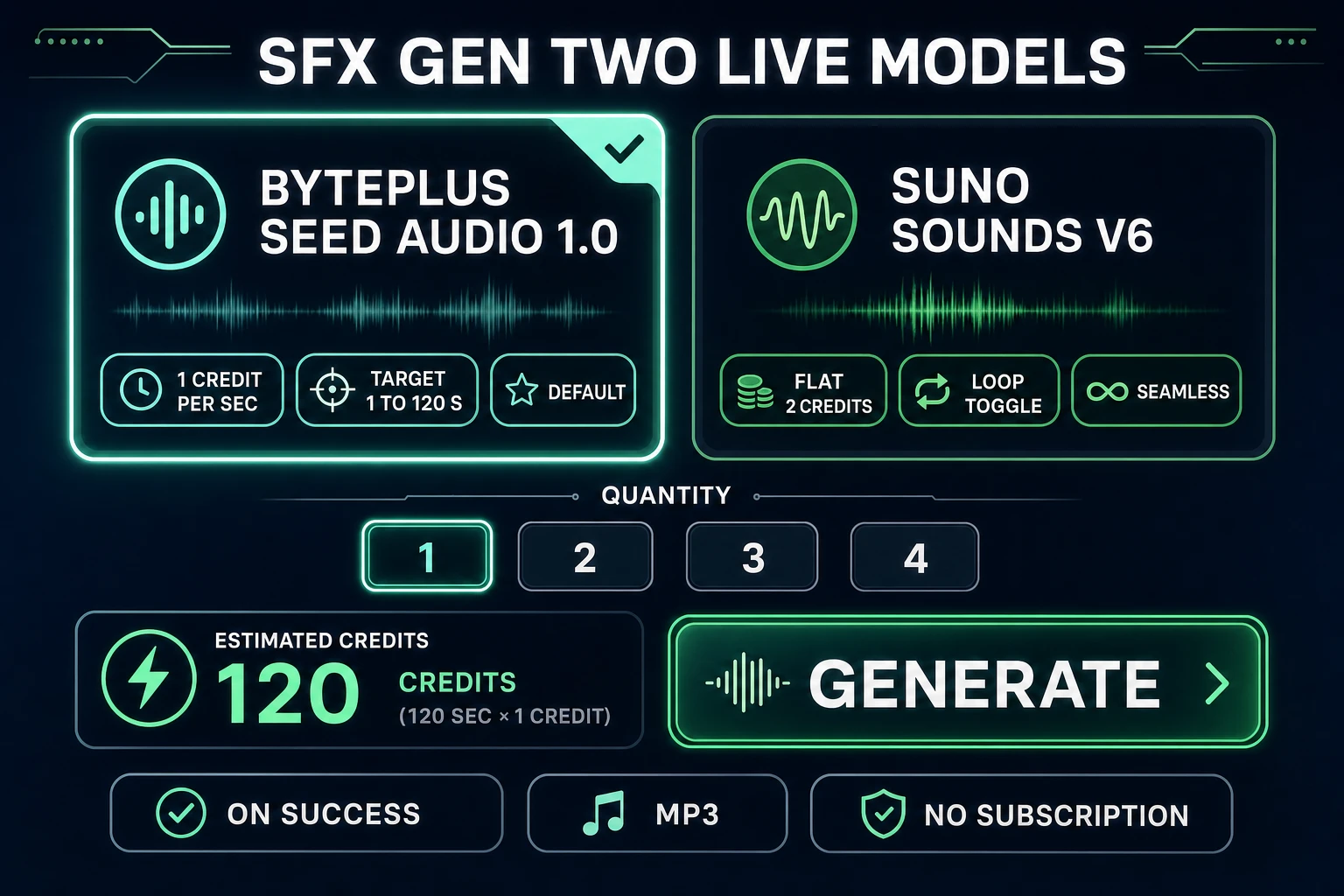
SFX Gen two-model picker: BytePlus Seed Audio 1.0 at 1 credit per second with 1 to 120 second target duration, Suno Sounds V6 at flat 2 credits with loop toggle, Quantity 1 to 4
SFX Gen picker: Seed Audio for length-controlled one-shots, Suno Sounds V6 for flat-rate loops. One Quantity row, one estimated cost, one Generate button.

Four criteria that decide which AI sound effects generator wins for a game

Buyer intent on this query sorts cleanly into four questions. Score each tool on each:

  1. Length control. A UI click wants 0.3 s. A sting wants 2 s. A looping bed wants 10–30 s. Length control is the difference between “trim 4 seconds of silence off every file” and “drop the file straight into the engine.” Seed Audio exposes a target-duration slider from 1 to 120 seconds; Suno Sounds V6 is flat regardless of length but caps at a reasonable short clip for one-shots.
  2. Loop seamlessness. Ambience loops need the end sample to match the start sample. Suno Sounds V6 has a seamless-loop toggle; Seed Audio 1.0 does not advertise one. For ambient beds, pick Suno; for jumps and clicks, pick Seed.
  3. Credit transparency. A $20/month SFX subscription that generates 50 clips a month costs 40 cents per clip; a 2-credit Suno Sounds call is 2 cents. The success-only billing model wins when a jam only needs 15 keepers out of 40 prompt tries.
  4. Export format. The pack lands as mp3 in /audio/sfx/. MP3 loads natively in HTMLAudioElement.src per the MDN HTMLAudioElement docs (checked 2026-10-02) and decodes to an AudioBuffer for the Web Audio API (checked 2026-10-02). Both calls work in Phaser, three.js, Godot 4.7, and Unity.

Sorceress SFX Gen scores well on all four because it does not pick one provider — it exposes both and lets you choose per clip. That is the aggregator advantage over dedicated-SFX subscription tools: no single-vendor lock-in on the length-vs-loop tradeoff.
Credit math at 100 credits per US dollar

Worked examples pulled from the verified constants (SEED_AUDIO_CREDITS_PER_SECOND = 1, SUNO_SOUNDS_CREDIT_COST = 2, CREDITS_PER_DOLLAR = 100, all verified 2026-10-02):

Clip Model Target length Credits USD
UI clickSeed Audio 1.01 s1$0.01
Jump whooshSeed Audio 1.02 s2$0.02
Combat hitSeed Audio 1.03 s3$0.03
Coin pickup chimeSuno Sounds V6flat2$0.02
Ambient forest loopSuno Sounds V6flat w/ loop2$0.02
Cinematic impactSeed Audio 1.015 s15$0.15
Quantity 4 A/B of a jumpSeed Audio 1.02 s each8$0.08
Full jam hit packmixed~20 clips~45~$0.45

A 20-clip hit pack for a weekend game costs roughly 45 US cents on the Sorceress ledger. The SIGNUP_GRANT = 100 baseline covers that out of the gate with credit to spare for a second pass. There is no subscription floor, no minimum monthly commitment, and no provider lock-in. The “ai sound effects generator free” sub-query lands here because the per-clip cost is micro, not because there is a free tier.

Trim, loudness-match, and ship with SFX Editor

Every AI-generated take needs a cleanup pass. Wikipedia’s Sound effect entry (verified 2026-10-02) splits motion-picture sound effects into four buckets — hard SFX, background, Foley, and design. A game SFX pack from an AI generator covers the hard SFX and design branches cleanly; background ambience lives in Suno Sounds V6 loops; Foley stays with a human artist for anything that has to sync to a specific animation frame.

SFX Editor is badged Pro in the home catalog (verified 2026-10-02 in src/app/_home-v2/_data/tools.ts line 687). It covers:

  • Strip leading silence so the transient lands on frame zero.
  • Fade the last 20–40 ms so repeated jumps do not click on consecutive triggers.
  • Normalize peak loudness across the pack so a confirm chime is not three times louder than its sibling click.
  • Export mp3 at a consistent sample rate (44.1 kHz or 48 kHz) so engine decode paths stay predictable.

If the Pro gate is a blocker during a jam, Sound Studio at /tools/audio-suite gives the same library view (music, SFX, and voice in one place) under AI Credits and covers basic trim and fade. Either path beats shipping a 2-second silence pad on every jump trigger.

Rule of thumb: do not bake a music bed under a hit. Beds belong in Music Gen, voice lines belong in the voice path covered by AI voice generator character, and hit SFX stay as discrete mp3 files that the engine mixes in real time. Keeping the channels separate is also what Wikipedia’s Sound effect article (checked 2026-10-02) explicitly recommends — dialogue, music, and sound effects are treated as separate elements in professional production. The same discipline keeps a jam pack playable six months later when you want to drop in a new impact without re-rendering the music.

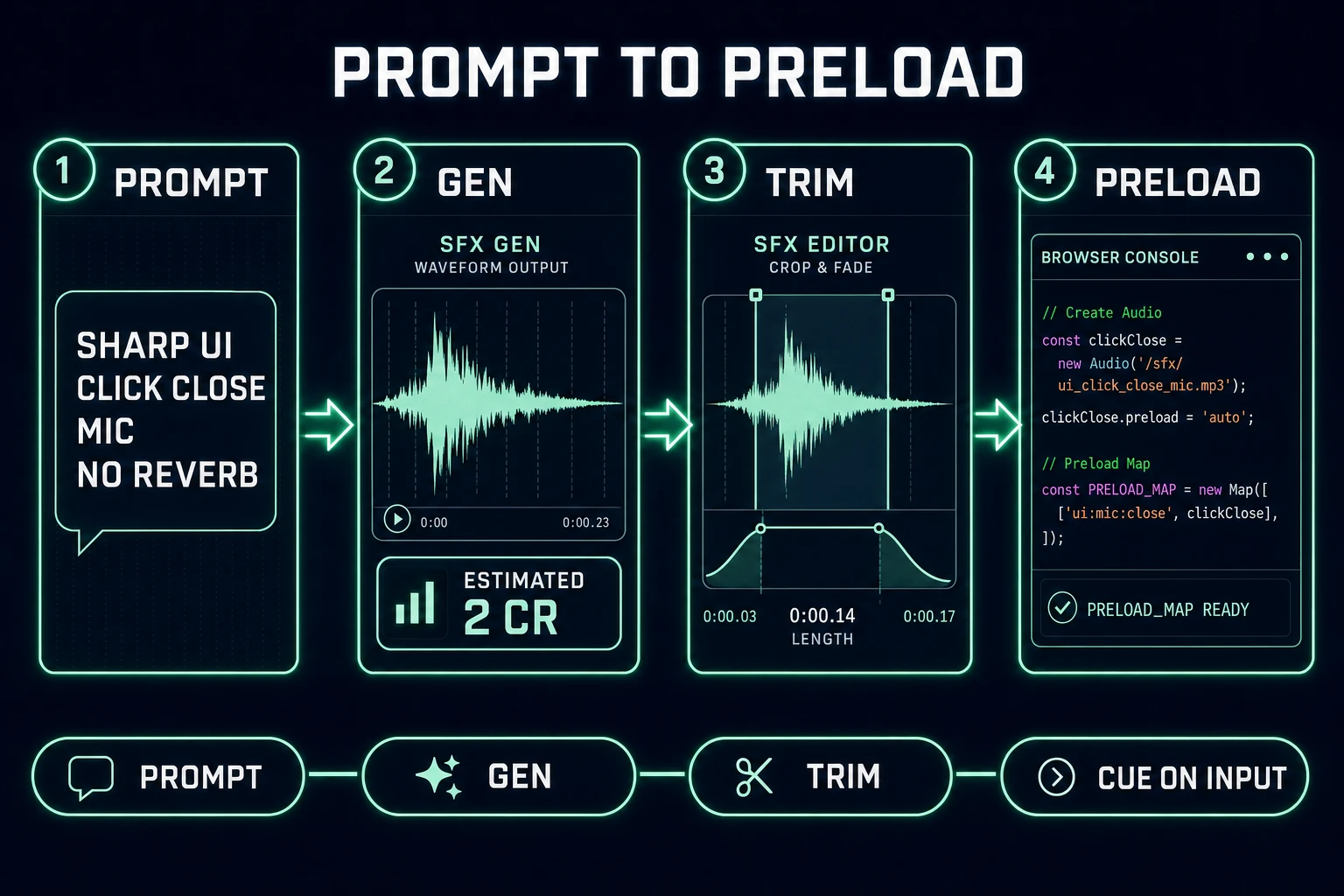
Browser SFX pipeline: prompt in SFX Gen, generate mp3 clip, trim and fade in SFX Editor, preload into HTMLAudioElement Map and cue on user input
From prompt to preload: SFX Gen generates, SFX Editor trims, HTMLAudioElement cues on input. One pipeline, three steps.

Cueing the pack in a browser game

MDN’s HTMLAudioElement docs (checked 2026-10-02) are the right primer: construct with new Audio(url), call .play(). The constructor accepts a URL; the element inherits src, currentTime, duration, and volume from HTMLMediaElement. For games the practical pattern is a preload Map built on the loading screen so the first jump trigger does not wait for a network round-trip:

const sfx = new Map();
function preload(id, url) {
  const a = new Audio(url);
  a.preload = 'auto';
  sfx.set(id, a);
}
async function playSfx(id) {
  const a = sfx.get(id);
  if (!a) return;
  a.currentTime = 0;
  try { await a.play(); } catch (err) { /* autoplay blocked */ }
}

The autoplay catch block matters. MDN’s Autoplay guide for media and Web Audio APIs (checked 2026-10-02) is explicit: “media will be allowed to autoplay only if at least one of the following is true: the audio is muted or its volume is set to 0; the user has interacted with the site (by clicking, tapping, pressing keys, etc.); if the site has been allowlisted; if the autoplay Permissions Policy is used to grant autoplay support.” A hit sound triggered on a jump input is already past the user-gesture gate, but a title-screen stinger triggered on load is not. Wire the first SFX to a click-to-start button and the rest of the pack unlocks for the session.

For overlapping impacts (machine-gun fire, chained spells), one Audio element cannot play its own clip twice simultaneously — the second trigger cuts the first. Two patterns solve this:

  1. Clone a fresh element per trigger (new Audio(a.src)), play, discard. Cheap for a dozen simultaneous cues; expensive for hundreds.
  2. Decode the mp3 once into an AudioBuffer via the Web Audio API (checked 2026-10-02) and schedule many AudioBufferSourceNode instances off the same buffer. Scales to hundreds of overlapping fires per second.

Pattern 1 is enough for most 2D jams. Pattern 2 earns its complexity in bullet-hell or weapon-ping-heavy games.

Picking the right AI sound effects generator for your project

The ranking collapses to three plain-text rules:

  • Pick Sorceress SFX Gen (Seed Audio 1.0 default) if you need length-controlled one-shots, pay-per-clip billing, and a single wallet that also funds Music Gen, Speech Gen, and the rest of the audio suite. This is the right pick for an indie weekend game, a jam, or a prototype where the SFX pack has to ship in a day.
  • Pick Sorceress SFX Gen (Suno Sounds V6) if you need an ambient loop that stitches cleanly or a flat-rate design hit where the length does not matter. This is the right pick for ambience beds and anything that benefits from the loop toggle.
  • Pick a dedicated SFX subscription tool only if you ship enough clips per month that the subscription math beats 2 cents per Suno Sounds call. For a studio shipping multiple titles a quarter the math can flip; for an indie or jam it rarely does.

None of those picks need you to replace a Foley artist. The Foley role still owns the sync-to-picture work the AI cannot do.

The verdict

An AI sound effects generator in 2026 is a shopping decision between three categories: dedicated text-to-SFX subscription tools, general music models stretched to one-shots, and browser aggregators that pay per clip and swap models mid-pack. For indie game dev the aggregator pattern wins on cost math and ships faster than a subscription. Sorceress SFX Gen is the aggregator pick: BytePlus Seed Audio 1.0 at 1 credit per second for length-controlled one-shots, Suno Sounds V6 at a flat 2 credits for seamless loops and design hits, Quantity 1 through 4 for variations, and SFX Editor for the cleanup pass. Pair with Music Gen for beds and the voice path in AI voice generator character for dialogue; the same wallet funds all three. The free-intent sibling query is covered in AI sound effects generator free hit pack — this page stays on the ranked-tool question. See the Sorceress Tools Guide for the full picker in context, or jump straight into Sorceress to spend the signup grant on your first ten clips.

Frequently Asked Questions

Is the Sorceress AI sound effects generator free to try?

SFX Gen is badged AI Credits, not Free, in the home catalog (verified 2026-10-02 in src/app/_home-v2/_data/tools.ts). The 100-credit signup grant (verified 2026-10-02 in src/app/api/admin/credits/route.ts) covers roughly 50 Suno Sounds V6 clips at a flat 2 credits each, or 100 one-second Seed Audio clips at 1 credit each. One credit equals one US cent at the top-up ledger (CREDITS_PER_DOLLAR = 100 in src/lib/models.ts). That is the practical free tier for a jam.

Can an AI sound effects generator replace Foley or a stock SFX library?

Not fully. Wikipedia's Foley entry (checked 2026-10-02) splits Foley into feet, moves, and specifics performed in sync with the picture - the sync dimension is what AI misses. Generated clips cover the hard SFX and design SFX branches of the Wikipedia Sound effect hierarchy (checked 2026-10-02) well. For hand-synced footsteps or cloth movement, a Foley artist still wins. For UI clicks, combat impacts, and ambient one-shots, the AI path ships faster and cheaper.

What file format does Sorceress SFX Gen export?

SFX Gen outputs playable audio URLs that download as mp3 (verified 2026-10-02 in src/app/sfx-gen/page.tsx). MP3 loads in HTMLAudioElement.src natively (MDN HTMLAudioElement, checked 2026-10-02) and plays through the Web Audio API's decodeAudioData path if you need buffer control. Both load cleanly in Phaser, three.js, Godot 4.7, and Unity.

How many SFX variations should I generate per prompt?

SFX Gen Quantity offers 1 through 4 variations per run (verified 2026-10-02 in src/app/sfx-gen/page.tsx) and estimated credits multiply by that count. Keep Quantity at 1 while the prompt is still being tuned. Only roll Quantity 2 once the prompt reliably lands and you want A/B keeps. Rolling Quantity 4 blind spends 4x the credits for a 25% keep rate at best.

Does the AI sound effects generator work for commercial game releases?

SFX Gen generations route through the Sorceress API to BytePlus Seed Audio 1.0 or Suno Sounds V6 (both verified 2026-10-02 in src/app/sfx-gen/page.tsx). Review the current Sorceress Terms of Service for commercial-use terms on generated audio the same way you would for any AI-generated asset in your pipeline. Practical shipping pattern: credit the AI source on the game's about screen, back up the exported mp3 files, and keep the prompt sheet in version control so you can regenerate on request.

Sources

  1. Sound effect - Wikipedia
  2. Foley (sound design) - Wikipedia
  3. Autoplay guide for media and Web Audio APIs - MDN
  4. HTMLAudioElement - MDN Web Docs
  5. Web Audio API - MDN Web Docs
Written by Arron R.·2,786 words·12 min read

Related posts