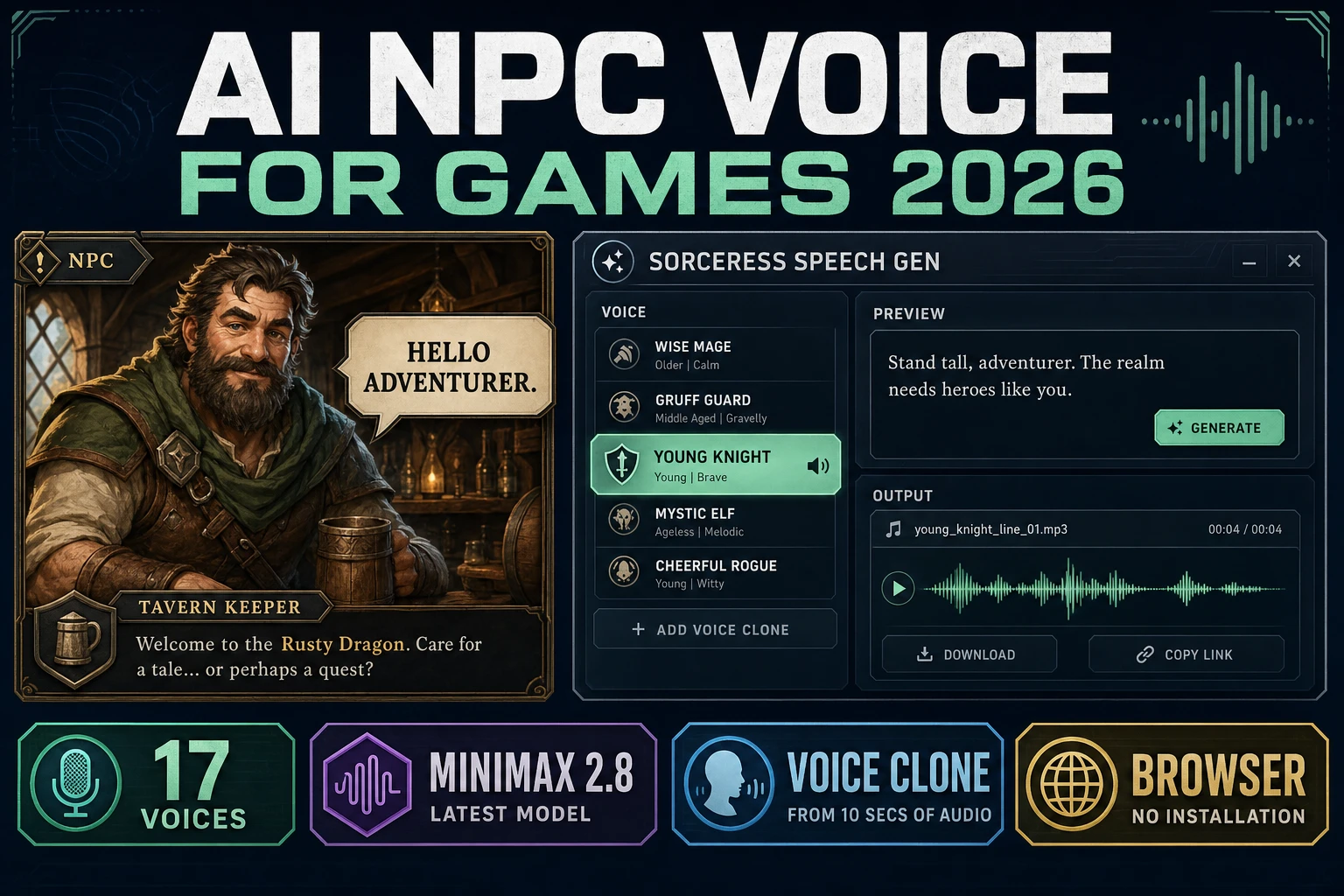
AI NPC Voice for Games (Dialogue Pack 2026)

By Arron R.10 min read
AI NPC voice for a small game in 2026 is Sorceress Speech Gen: 17 preset MiniMax Speech 2.8 HD voices, voice cloning at 400 credits, 1 credit per 2,000 characte

Searchers who type ai npc voice in 2026 usually want one very specific thing: a way to give every non-player character in a small game its own recognizable speaker without booking a studio, chasing takes, or paying for a subscription that outlasts the project. The 2026 answer on the Sorceress stack is Speech Gen, a browser-side tool that runs MiniMax Speech 2.8 HD under the hood, exposes 17 preset voices out of the box, adds voice cloning at 400 credits, and pipes each result out as a single mp3. The rest of this piece is a working recipe: cast the roster, prompt the emotions, clone a hero voice, and wire the mp3 into the game through WizardGenie. Every fact below was verified 2026-09-04 against src/lib/sorceress-tools/audio/speech.ts, src/app/speech-gen/page.tsx, and the Tools Guide.
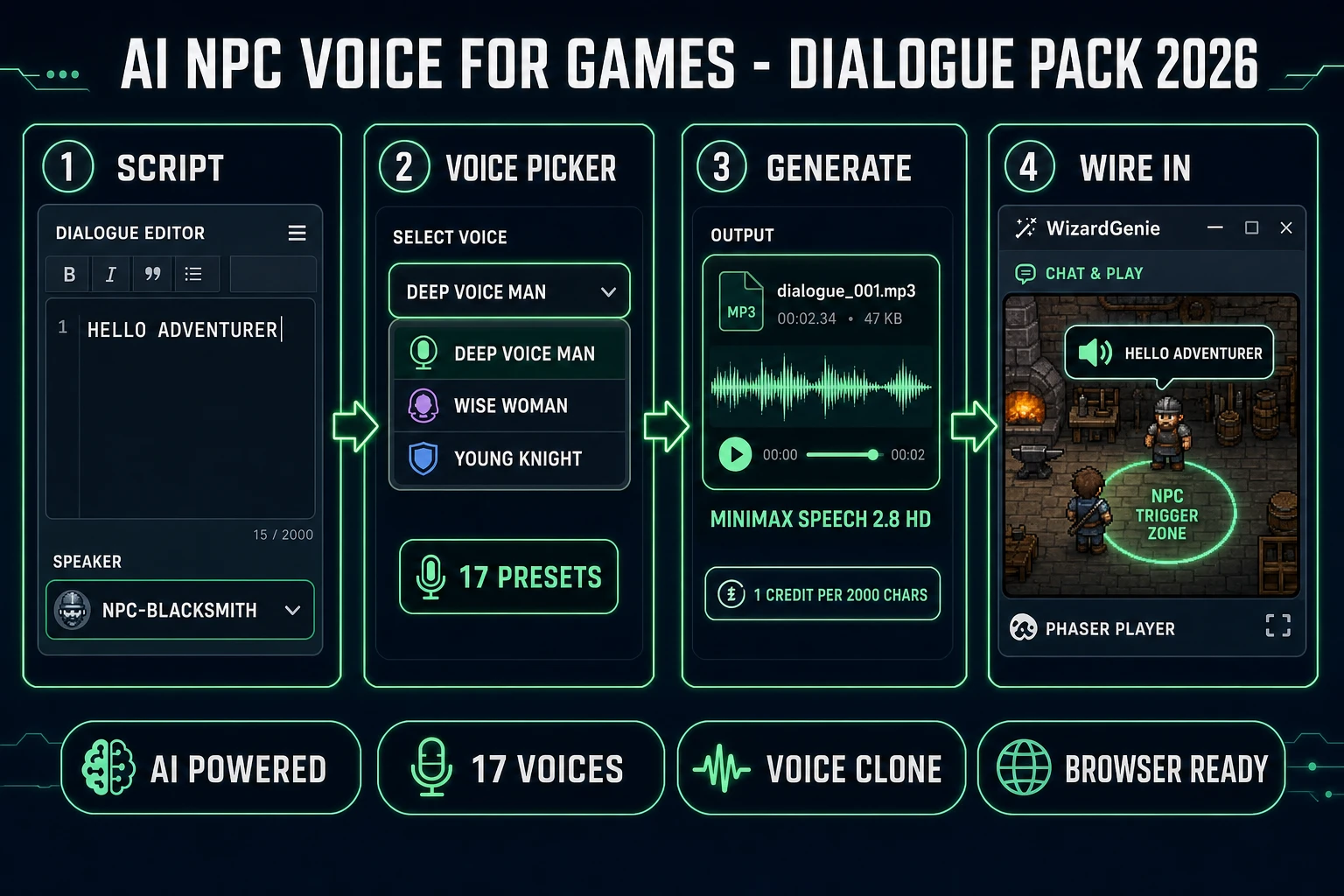
AI NPC voice for games diagram 2026: dialogue editor, 17 voice presets on MiniMax Speech 2.8 HD, mp3 output card, WizardGenie wire-in with a Phaser player entering an NPC trigger zone
The 2026 AI NPC voice pipeline: pick a preset (or clone your own), generate a MiniMax Speech 2.8 HD mp3, and wire it into the browser game through WizardGenie.

What ai npc voice actually means in a 2026 indie project

Three overlapping meanings hide inside the phrase ai npc voice, and mixing them up wastes a weekend. NPC barks are the tiny one-liners that trigger on proximity or interaction ("Halt, traveler." "Have you seen my sheep?"). They are 40 to 80 characters and repeat often, so they need to sound alive without stalling the frame. Dialogue trees are the branching conversations that live behind a talk key; each node is a few sentences and every branch needs the same speaker to sound like the same person. Codex lore is the paragraph-long readable that a player can trigger from an in-world book or a Bestiary entry - hundreds of characters, one call, one file.

All three want an ai npc voice that is consistent within a character and distinct between characters. The unhonest answer is "just use TTS." The honest answer is the specific pairing of a preset roster and a cloning path so the important speakers - the hero, the villain, the mentor - can be a chosen voice while the crowd characters pull from a curated preset list. That is exactly the shape Sorceress Speech Gen has today, and it is why the tool sits under the Audio Studio group on the home page next to Music Gen and SFX Gen.

Why an ai npc voice pipeline beats recorded VO for a small game

Recorded voice-over is still the gold standard when the budget is real and the schedule is long. Neither is true for an indie browser game in 2026. A recorded pipeline needs a script lock, a session, retakes, edits, and a licensing conversation before a single line hits the build. An ai npc voice pipeline turns each line into a text-to-mp3 call - 1 credit per 2,000 characters on the Sorceress API side (verified 2026-09-04 in the ttsCost function of src/lib/sorceress-tools/audio/speech.ts), minimum 1 credit, billed only on success.

Three concrete gains follow. First, iteration cost drops to near zero: a designer edits a bark, hits generate, and the new mp3 replaces the old one before the next playtest. Second, the game can carry more characters: 20 NPCs cost roughly 20 credits for a full first pass of short barks. Third, the tone stays consistent across a project because the same preset (or the same cloned voice) is a single deterministic id in the payload, not a different actor on a different day. Speech synthesis is not new - the Wikipedia article on speech synthesis traces the field back decades - but the 2026 quality bar makes it credible for shipped indie work in a way it was not five years ago.

The Sorceress Speech Gen surface for an ai npc voice roster

Speech Gen is the tool that turns a script into an ai npc voice mp3. Under the hood it drives MiniMax Speech 2.8 HD, verified 2026-09-04 in src/lib/sorceress-tools/audio/speech.ts (model id hd, summary line "Text-to-speech via MiniMax Speech 2.8 HD"). The relevant knobs for casting a roster:

  • 17 preset voices split nine male and eight female. The male shelf includes Deep Voice Man, Casual Guy, Patient Man, Young Knight, Determined Man, Decent Boy, Imposing Manner, Elegant Man, and Friendly Person. The female shelf includes Wise Woman, Calm Woman, Inspirational Girl, Lively Girl, Lovely Girl, Abbess, Sweet Girl, and Exuberant Girl. Names come straight from the PRESET_VOICES array on 2026-09-04 - no invention.
  • Eight emotion tags: none, happy, calm, sad, angry, fearful, disgusted, surprised. Set through the emotion parameter; default is none. Emotions do not change the price.
  • Speed 0.5 to 2.0 (default 1), pitch -12 to 12 (default 0), volume multiplier, and language_boost - all optional and all free of surcharge.
  • 10,000-character cap per call. A short bark burns one credit; a full 10,000-character codex entry burns five. There is no per-second billing to trip on.
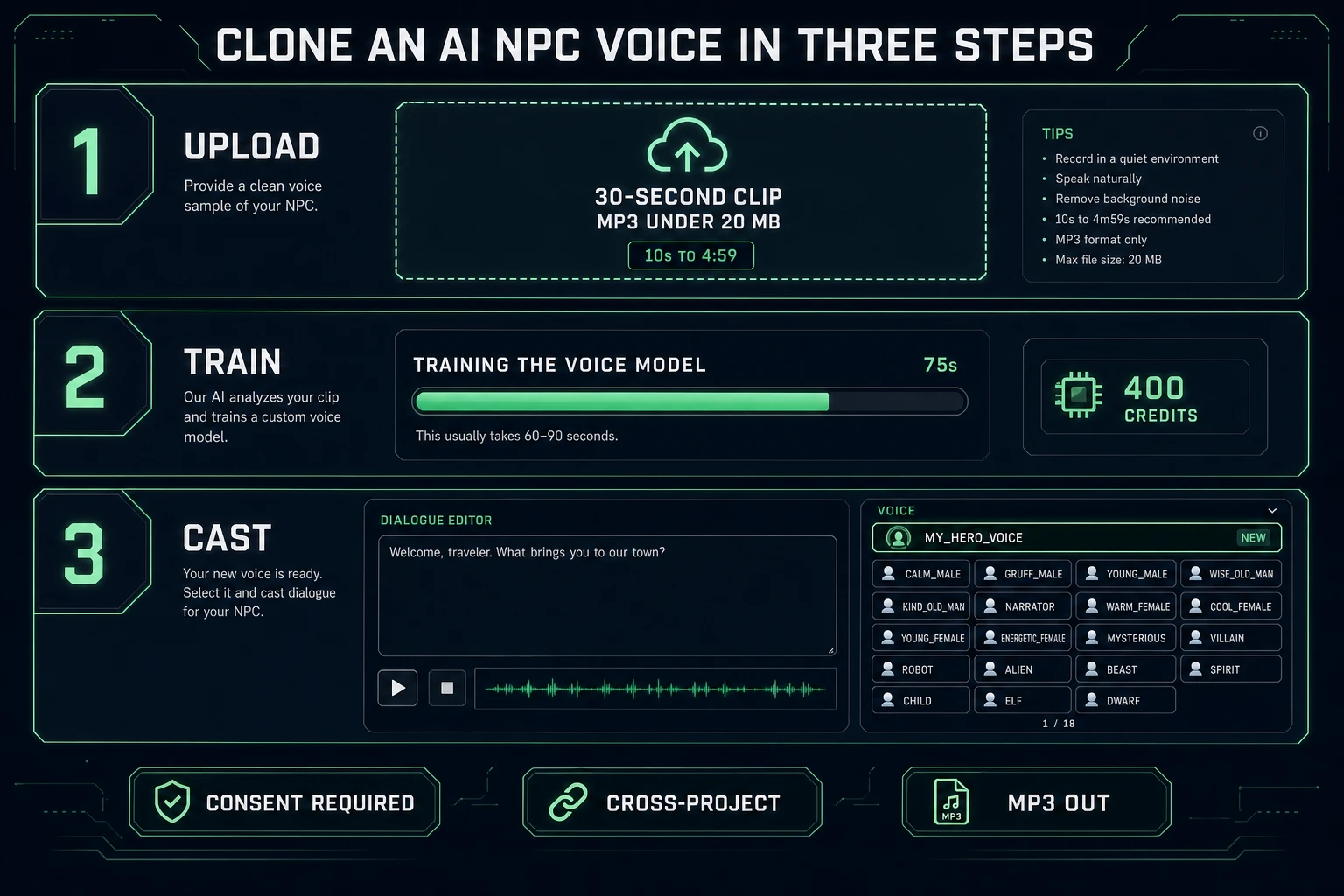
  • Voice cloning. 400 credits per clone, 10-second to 4:59 sample, up to 20 MB, roughly 75-second training turnaround. Cloned voice ids sit alongside the presets in the same picker.

None of this is a subscription; it is credit-metered. Read the current tool credits and lifetime tiers on the Sorceress plans page before locking a budget. The one thing Speech Gen does not do is master or mix the file - the mp3 comes out at the model's default level. If a line lands hot next to a music bed, pull it into SFX Editor or the DAW of your choice for gain-staging.
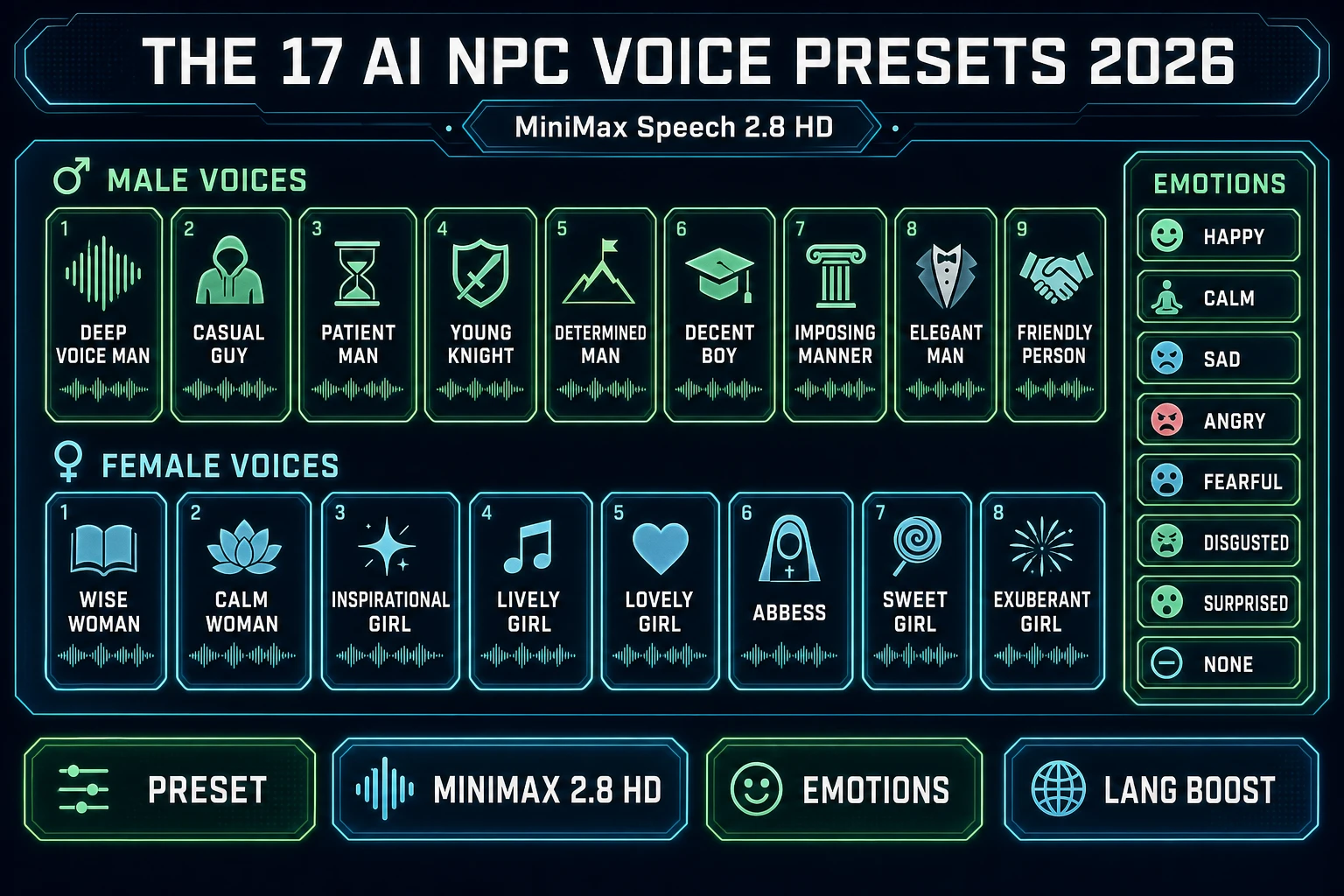
The 17 AI NPC voice presets 2026 diagram: nine male and eight female MiniMax Speech 2.8 HD voice chips plus emotion tags
The 17-voice preset roster on MiniMax Speech 2.8 HD, plus the eight emotion tags. Casting an ai npc voice project starts by assigning presets to speaker roles.

Cast an ai npc voice roster in five steps

The workflow below assumes a small game with a hero, a villain, and eight background NPCs. It is the shape 90 percent of jam projects and 60 percent of Early Access indie games have.

  1. Write a one-page speaker sheet. Name each NPC, its role (blacksmith, guard, elder, child, merchant, quest-giver), and one adjective for tone ("gruff", "warm", "hurried"). Ten NPCs fit on a single page. Do not write dialogue yet - just cast.
  2. Assign a preset per speaker. Open Speech Gen, click Preview on each preset, and tag the matching voice next to each NPC. Young Knight suits the recruit; Imposing Manner suits the antagonist; Wise Woman suits the elder; Lively Girl suits the merchant's daughter. Two NPCs can share a preset if the emotion tag differs enough to make them read distinct.
  3. Bulk-generate the barks. For each NPC, paste 5 to 12 short lines (40 to 80 characters each). Set the emotion once (angry for the guard, calm for the elder, happy for the child). Hit generate; save each mp3 to public/audio/npc/<npc-id>/<line-id>.mp3 in the game project. A 10-NPC pass at ten lines each is 500 characters per NPC - one credit per NPC, ten credits total.
  4. Preview in isolation, then in-scene. Play each mp3 solo first; then drop the file into the game and trigger it near the intended music bed. Barks that were fine solo sometimes read too hot over combat music - re-generate with pitch -2 and speed 0.95 instead of reaching for a volume slider.
  5. Version-lock the manifest. Save a small JSON alongside the mp3 folder listing npc, line_id, text, voice_id, and emotion. Two months from now when a producer asks "can we regenerate this with a different emotion", the manifest is the reproducible source of truth. A screenshot of the Speech Gen UI is not.

That is the whole loop. A game jam-scale roster - 10 NPCs, 100 lines - clears in an afternoon and burns roughly 10 credits. Compare that to what a single evening at a rented studio costs and the trade-off is obvious.
Prompt patterns that make an ai npc voice feel alive

Preset selection is only half of the credibility problem. The other half is how the line is written. Speech Gen respects punctuation, capitalization, and the emotion tag; it does not respect stage directions in parentheses. Three patterns that consistently sound better on MiniMax Speech 2.8 HD:

  1. Punctuate for breath. A comma is a pause; an em dash is a longer beat; three dots slur into a trailing thought. "Halt... traveler." reads slower and more menacing than "Halt, traveler." even at the same speed setting.
  2. Match the emotion tag to the punctuation. An angry line should end on an exclamation mark; a sad line should trail off with three dots; a fearful line should use short clauses separated by commas. The tag steers the acting; the punctuation steers the pacing.
  3. Rewrite for the voice. Deep Voice Man will drop the second half of a rushed compound sentence; Lively Girl will over-elevate a plain declarative. Read a line aloud in the preset's voice class before generating; edit the text if it does not scan.

What to avoid: stage directions like "(nervously) I don't know what you mean" - MiniMax will read the parenthetical as text. Long parentheticals like "(under his breath, glancing at the door)" are the single most common reason a preview sounds wrong. Rewrite the intent into the sentence itself ("I don't know what you mean, please, keep your voice down") and set the emotion to fearful.

Voice cloning for a consistent hero ai npc voice

Presets carry the crowd. Cloning carries the leads. Voice cloning on Speech Gen costs 400 credits per clone (verified 2026-09-04 in src/app/speech-gen/page.tsx, VOICE_CLONE_CREDITS = 400), accepts a 10-second to 4:59 sample, and caps the upload at 20 MB. The training job runs on Replicate through MiniMax and typically returns in about 75 seconds.

Three real-project sizing rules:

  • Do not clone a public figure or a coworker without written consent. The speech synthesis Wikipedia entry summarizes the ethics; the short version is "cloning is fine when the source has agreed and the use is disclosed." Cloning a colleague as a joke on a shipped build is not fine, ever.
  • Clone the hero and the villain, not the crowd. The whole point of a preset roster is that background characters do not need bespoke voices. Spend the 400 credits where the player will spend the most listening time.
  • Record a clean sample. A 30-second read from a quiet room outperforms a 4-minute stitched clip from a noisy laptop mic. MiniMax Speech 2.8 HD infers timbre and cadence from the sample; noise contaminates both.

Once the clone is trained, the new voice id sits in the picker next to Deep Voice Man and Wise Woman. From there the per-line billing (1 credit per 2,000 characters) is identical to the preset lane. The 400-credit floor is a one-time cost, not a rental.

Clone an AI NPC voice in three steps diagram: upload a 30-second mp3 sample, train the voice model in 75 seconds for 400 credits, cast the custom voice alongside 17 presets
Clone an ai npc voice in three steps: upload a clean sample, wait about 75 seconds for training, and cast the custom voice id alongside the 17 MiniMax presets.

Wire the ai npc voice mp3 into a WizardGenie game

The last step is the one most tutorials skip: getting the mp3 into the actual game loop. Speech Gen returns a single mp3 URL per call. The Sorceress-native pattern is to let WizardGenie do the wiring. Open a new project, drop the mp3s into public/audio/npc/, and ask the agent to preload every line into a keyed map before the first level starts:

// npc-voice.ts
const barks = new Map<string, HTMLAudioElement>();
for (const {npc, line} of manifest) {
  const a = new Audio(`/audio/npc/${npc}/${line}.mp3`);
  a.preload = "auto";
  barks.set(`${npc}:${line}`, a);
}
export function playBark(key: string) {
  const a = barks.get(key);
  if (a) { a.currentTime = 0; a.play(); }
}

That block relies on the standard HTMLAudioElement - no extra library, no polyfill, no worker. Trigger playBark("blacksmith:hail") from the NPC's proximity check and the ai npc voice fires the frame the player enters the trigger volume. For richer audio work (per-source panning, ducking under music), swap to the Web Audio API and load each mp3 into an AudioBufferSourceNode; that is the correct upgrade path when a project starts caring about spatial sound.

Two accessibility notes worth putting in the same wire-in pass: mirror every bark as text in a live region so a screen reader will announce it (the W3C aria-live specification is the canonical reference), and expose a "voice volume" slider distinct from the music and SFX sliders. Both are ten-line additions in WizardGenie and both are things a marketplace like itch.io or a storefront review will flag if missing.

What an ai npc voice pack for a first game costs on Sorceress in 2026

A concrete budget for a first browser game with 10 NPCs, 12 lines each (about 60 characters average) plus two cloned hero voices:

  • 10 NPCs × 12 lines × 60 chars ≈ 7,200 characters ÷ 2,000 = 4 credits for barks (rounded up).
  • 1 cloned hero voice = 400 credits.
  • 1 cloned villain voice = 400 credits.
  • Two cloned voices × 30 lines × 120 chars ≈ 7,200 characters = 4 credits.
  • Total: 808 credits for a full first ai npc voice pass on a shipped browser game.

Compare that to a rented studio evening. The trade-off is not close. And because every artifact is a plain mp3 file, the game can drop the whole pack into its build folder without a licensing dependency at runtime, which matters for anyone shipping to Sorceress Publishing or a marketplace like itch.io.

Verdict, holding steady on 2026-09-04: the shortest honest path to an ai npc voice pack for a small game in 2026 is Sorceress Speech Gen on MiniMax Speech 2.8 HD with 17 presets for the crowd and one or two clones for the leads, wired into the game through WizardGenie. Complementary reads: the roster-level pipeline in Cast an AI Character Voice Generator and the audio-adjacent effects lane in Fire an AI Sound Effects Generator. Together they are the whole audio surface for a first Sorceress game.

Frequently Asked Questions

What is the best AI NPC voice generator for indie games in 2026?

For a small indie game in 2026 the best AI NPC voice generator is Sorceress Speech Gen at /speech-gen. Verified 2026-09-04 against src/lib/sorceress-tools/audio/speech.ts and src/app/speech-gen/page.tsx: it ships 17 MiniMax Speech 2.8 HD presets across nine male and eight female voices, supports voice cloning at 400 credits per clone (10 to 299 second sample, up to 20 MB), and bills 1 credit per 2,000 characters on the API side, minimum 1. That covers a full NPC roster for the price of a single frontier reasoning call.

How much does AI NPC voice cost per line inside Sorceress Speech Gen?

The API pricing is 1 credit per 2,000 characters (whole credits, minimum 1), verified 2026-09-04 in the ttsCost function in src/lib/sorceress-tools/audio/speech.ts. A typical NPC barks around 40 to 80 characters, so one credit will cover roughly 25 short lines. A dense codex-style lore dump at 2,000 characters is also one credit. The in-app editor at /speech-gen exposes an HD rate of 0.5 credits per 1,000 characters and a Turbo rate of 0.3, both charged only on success.

Can I clone my own voice for an AI NPC voice pack?

Yes. Speech Gen ships voice cloning at 400 credits per clone. Verified 2026-09-04 in src/app/speech-gen/page.tsx: uploads must be between 10 seconds and 4:59 long, no larger than 20 MB, and the training job runs in about 75 seconds. Once trained, the cloned voice id sits alongside the 17 MiniMax presets in the voice picker and the per-line billing (1 credit per 2,000 characters) is identical to the presets.

Which emotions and controls does the AI NPC voice generator support?

Emotions supported today are none, happy, calm, sad, angry, fearful, disgusted, and surprised - eight options, verified 2026-09-04 in the EMOTIONS array in src/lib/sorceress-tools/audio/speech.ts. Alongside emotion, every generation accepts optional speed (0.5 to 2.0), pitch (-12 to 12), volume, and language_boost (a language hint like English or Spanish). None of the optional controls change the price.

How do I wire an AI NPC voice mp3 into a Phaser or Three.js game?

Speech Gen returns a single mp3 URL per call. Drop it in WizardGenie by asking the coding agent to preload the file with HTMLAudioElement or the Web Audio API and trigger playback on the NPC trigger volume. The pattern is roughly: new Audio(url), listen for canplaythrough, then call .play() when the player enters the NPC zone. For a full roster, preload every line in a Map keyed by NPC and dialogue id so no line stalls the first frame it plays.

Is an AI NPC voice pack allowed for a commercial browser game?

Sorceress Speech Gen output is licensed for use in the games you ship. The honest disclosure practice for AI voice in 2026 is to add a short credit in the game's about screen naming the tool - the pattern most jam and Steam pages already use for AI art. Voice cloning of a real person needs that person's written consent; do not clone a public figure or a coworker without it, and never use a cloned voice to impersonate someone in a way that could mislead a player.

Sources

  1. Speech synthesis - Wikipedia
  2. Web Audio API - MDN Web Docs
  3. HTMLAudioElement - MDN Web Docs
  4. WAI-ARIA aria-live - W3C
Written by Arron R.·2,316 words·10 min read

Related posts